
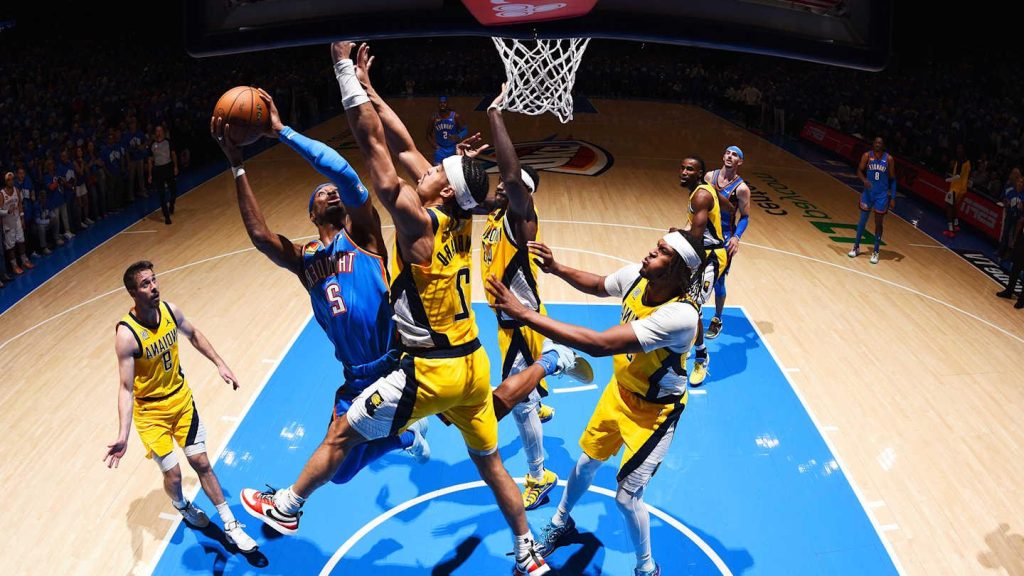
In a memorable scene at the Paycom Center last month, amidst a shower of confetti, the two central figures in Oklahoma City’s maiden NBA championship, Sam Presti and Shai Gilgeous-Alexander, were locked in a poignant embrace. Presti, the visionary executive determined to assemble a winning team in one of the NBA’s smaller markets, and Gilgeous-Alexander, the bright young talent Presti gambled his strategy on, had overcome significant challenges. These included long losing streaks and vocal criticism from pundits urging Presti to trade Gilgeous-Alexander. Their partnership saw the team’s victory tally soar from 22 wins in their second year to an impressive 68 this season, culminating in a championship triumph. Amid the growing celebration, they hugged and recognized their shared struggle, with Gilgeous-Alexander reflecting, “We both just said, ‘We made it to the mountaintop,’ We earned it.”
Powerball winner scoops $1.817 billion on Christmas Eve, what happens next will change their life forever
Zendaya shuts down pregnancy rumors after viral London outing with Tom Holland goes too far—here’s what she actually said
It has been almost a decade since Presti faced the uncertainty following Kevin Durant’s move to Golden State, which left the Thunder facing a bleak future. Attempts to build a winning team around Russell Westbrook alone, and later with Paul George, were unsuccessful. In 2019, Presti decided to completely dismantle the team. This daunting challenge came seven years after he initially assembled an unlikely NBA Finals team, which was overcome by the Miami Heat’s Big Three in five games.
During his initial three years as general manager, Presti drafted Durant, Westbrook, and James Harden, setting up what would become an ultimately unsuccessful dynasty in Oklahoma City. Following the disbandment of this core, in the subsequent four years, Presti brought in Gilgeous-Alexander and drafted Chet Holmgren and Jalen Williams, who have become the pillars of a new era. Today, nine out of the fourteen players on the Thunder’s Finals roster started their NBA careers in Oklahoma City. The team developed slowly, with strategic additions like Alex Caruso and Isaiah Hartenstein and strategic subtractions such as Josh Giddey and Darius Bazley to shape the team around Presti’s vision.
Arkansas lottery wins $1.817 billion Powerball jackpot on Christmas Eve, here’s what happens to the money
Powerball winner scoops $1.817 billion jackpot on Christmas Eve, but nobody knows who they are yet
What emerged, according to coach Mark Daigneault, is “an uncommon team,” marked by deep talent and strong connections, and unsurprisingly, achieving overwhelming success. Only two other teams—the 2015–16 Warriors and the 1995–96 Bulls—have ended a season with more wins than this Thunder team. These teams defined their respective eras, and Oklahoma City is poised to define this one.
The NBA has reached an era of unprecedented parity. This marks the seventh consecutive season where a different team has been crowned champion. No team has made consecutive Finals appearances during this period. Champions have emerged from both large markets (like Golden State and Boston) and smaller ones (such as Milwaukee and Denver), featuring stars from various countries including Serbia (Nikola Jokic), Greece (Giannis Antetokounmpo), and Canada (Gilgeous-Alexander). The former NBA commissioner David Stern once joked that his job mainly involved traveling between Boston and Los Angeles to present the championship trophies. In contrast, Adam Silver finds himself more often in the heart of America these days.
Stern, who passed away in 2020, would have appreciated this development. In 2011, determined to reduce the players’ share of basketball-related income and enforce a stricter salary cap, Stern initiated a lockout that lasted 161 days. He argued that the NBA needed a structure that allowed all 30 teams, if well-managed, to compete and be profitable. The league lost 240 games in the 2011-2012 season but gained a collective bargaining agreement that set the stage for this current era of parity. After 14 years, two more collective bargaining agreements, a change in commissioners (Silver, who had been a long-time deputy commissioner, succeeded Stern in 2014), and a spike in the salary cap, the league has achieved what it set out to do.
“The goal is that market size becomes essentially irrelevant,” Silver says. “It’s not about having a different champion every year, but about ensuring a fair chance for all.” Silver emphasized that the identity of the champion is not important. “Whichever team wins, even if they were to win again, I wouldn’t say, ‘This isn’t working because I didn’t go to a different city to hand out the trophy,’” Silver explains. “I’d say, ‘This is the system we wanted to establish, as long as the playing field is level.’”
This could mean that Silver will be spending a lot more time in Bricktown. Gilgeous-Alexander, the current MVP, is just 27 years old. Williams is 24 and fresh from his first All-NBA season, while Holmgren is 23. Organic growth alone should make the Thunder even stronger than the team that achieved a 16–7 record in the playoffs. “That’s the exciting part,” says Gilgeous-Alexander. “So many of us can still improve. There aren’t many of us who are at or even near our prime yet.”
Critics may see this as a familiar story. Milwaukee, led by then-26-year-old Antetokounmpo, was expected to dominate after their 2021 Finals victory. However, the Bucks have been eliminated in the first round in the three subsequent seasons. Denver, with a three-time MVP and a young supporting cast, has failed to return to the conference finals. Boston, before Jayson Tatum’s playoff injury, looked poised for multiple championships. Now, with Tatum likely out for most of next season, the Celtics are expected to cut costs and rebuild.
In brief: nothing is guaranteed. Yet, Oklahoma City seems uniquely positioned for success. In Milwaukee, the team has traded significant draft capital, including two first-round picks and two pick swaps to secure Jrue Holiday in 2020, to surround Antetokounmpo with championship-level talent. This has limited their ability to refresh their roster with younger, more affordable players.
In contrast, Oklahoma City has accumulated picks while building its team. The Clippers included five first-round picks and the rights to swap two more with Gilgeous-Alexander in 2019. Overall, the Thunder have seven first-round picks over the next four drafts. This is a remarkable amount of capital for a rebuilding team, and even more so for a defending champion. “They can basically replenish every offseason,” notes Bobby Marks, a former Nets executive.
Denver has managed to integrate young players around Jokic, but as it has shed expensive veterans in recent years (Bruce Brown, Kentavious Caldwell-Pope), its younger talent (Peyton Watson, Julian Strawther) has not adequately filled those roles. This has been a significant factor in the Nuggets’ struggles, as they have ranked in the bottom third for bench scoring over the past two seasons. Not surprisingly, they have been eliminated in the conference semifinals in seven games both years.
Meanwhile, the Thunder were the youngest team in the NBA at the start of the season and are the second youngest to ever win a title. The team has focused on living in the moment throughout the season. After their victory, it was hard not to think about what could be next. “I’m excited for the future of this team,” said Gilgeous-Alexander. “This is a great start.”
Mark Daigneault appeared amused. Two hours before a pivotal Game 5, a reporter—possibly this one—asked him during his pregame media session for a scouting report on Nikola Topic, the 2024 lottery pick who has been sidelined all season with a knee injury. Minutes later, Daigneault encountered the same reporter in the hallway. “What do you want to talk about after the game?” Daigneault inquired. “The draft?”
Maybe. Despite the awkward timing, it’s intriguing to consider Oklahoma City’s potential. Take Topic. The slender 6′ 6″ guard was a standout player in Europe during the 2023–24 season and a projected top-10 pick. A torn ACL ended his season just a month before the draft, causing him to fall to No. 12, where the Thunder, with little immediate need for a playable rookie, picked him up. In limited practice time, Topic has impressed. “He’s a modern NBA point guard,” says Thunder forward Kenrich Williams. “He plays like a 30-year-old veteran.” Everyone inside the organization—including Daigneault—is eager to see if Topic can make his way into Oklahoma City’s rotation.
Mike Johnson is a passionate news writer with a keen interest in current events. With over a decade of experience in journalism, he has a talent for uncovering the stories that matter most. Mike’s insightful articles and in-depth analyses have made him a trusted voice in the industry. He thrives on staying ahead of the news curve, providing readers with timely and relevant information. Whether it’s breaking news, politics, or social issues, Mike’s dedication to the craft ensures that his readers are always well-informed.
Red94 is an independent media. Support us by adding us to your Google News favorites: