
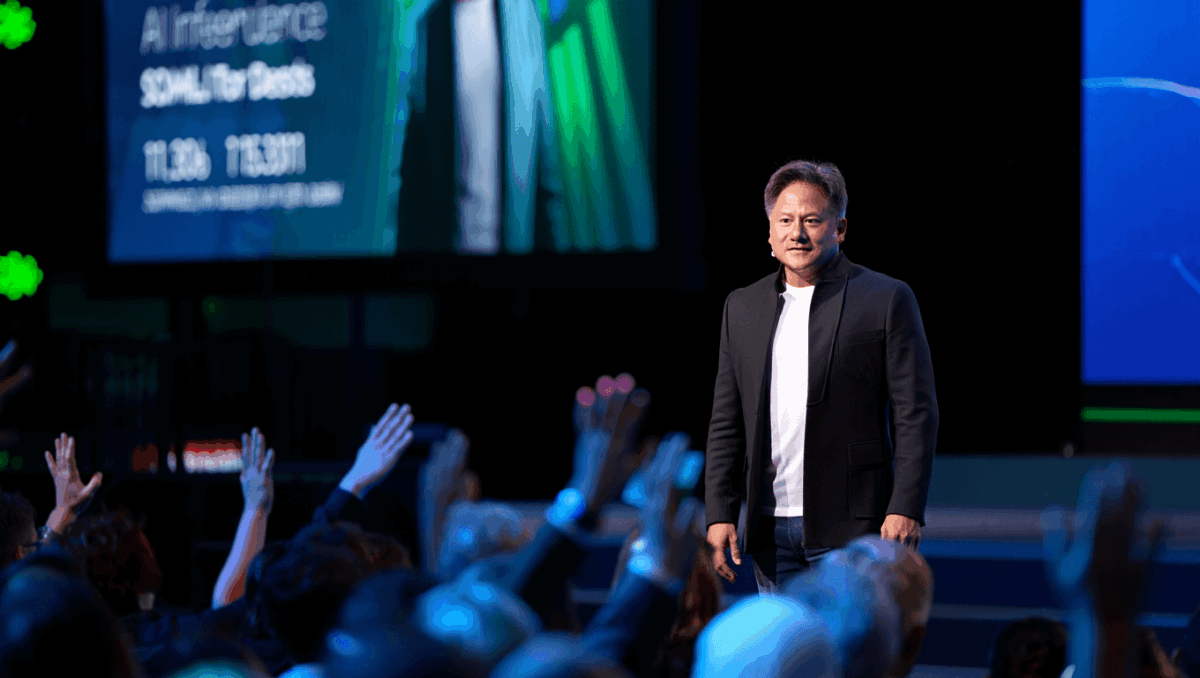
NVDA is making its largest acquisition ever on December 24, 2025, agreeing to acquire AI chip startup Groq for approximately $20 billion in cash. This strategic move represents NVDA’s biggest deal on record, surpassing its previous $6.9 billion acquisition of Israeli networking company Mellanox. The all-cash transaction signals NVDA’s commitment to dominating both AI training and inference markets amid intensifying competition.
🔥 Quick Facts
- Deal value: Approximately $20 billion in cash, marking NVDA’s largest acquisition ever
- Target company: Groq, a 9-year-old AI chip startup founded by Jonathan Ross, former Google engineer
- Key talent: Groq founder Jonathan Ross and president Sunny Madra joining NVDA as part of the deal
- Strategic focus: Acquiring Groq’s low-latency LPU (Language Processing Unit) technology for AI inference at scale
Why NVDA Paid $20 Billion for Groq’s Inference Technology
Intuit emerges as best software stock for 2026 while stock crashes to bargain levels analysts didn’t expect
2026 tax brackets shock Americans with hidden paycheck truth nobody expected
Groq’s LPU chips deliver exceptional performance for AI inference, achieving 300-500 tokens per second with latencies of just 1-2 milliseconds compared to NVIDIA GPU performance of 60-100 tokens per second with 8-10 millisecond latencies. This speed advantage makes Groq’s technology valuable for real-world AI applications from chatbots to large language model deployments. NVDA CEO Jensen Huang sees the acquisition as critical for expanding NVDA’s “AI factory” ecosystem architecture.
The deal is structured as a non-exclusive licensing agreement rather than a full acquisition, meaning Groq continues operating as an independent company with new CEO Simon Edwards. However, NVDA gains access to Groq’s specialized inference technology and its top engineering talent. Groq recently raised $750 million at a $6.9 billion valuation just three months prior, making the $20 billion deal a significant premium.
Groq’s LPU Technology: The Key Strategic Asset
| Technology Metric | Groq LPU | NVDA GPU (Typical) |
| Inference Speed | 300-500 tokens/sec | 60-100 tokens/sec |
| Latency Per Token | 1-2 milliseconds | 8-10 milliseconds |
| Batch Dependency | None | Performance sensitive |
| Memory Bandwidth | 80+ terabytes/sec (on-chip) | 8 terabytes/sec (off-chip HBM) |
Marcus Lemonis takes CEO role at Bed Bath & Beyond with $25M cost-cutting plan and watch what industry experts are saying about his next move
SPX surges 34 points at open with shocking tech recovery, here’s what caused the unexpected Venezuela rally
Groq pioneered the LPU in 2016, the first chip specifically designed for inference workloads. Unlike GPUs optimized for general computing and training, the LPU architecture focuses exclusively on inference speed and efficiency. Groq’s on-chip SRAM provides memory bandwidth upwards of 80 terabytes per second, versus GPU off-chip HBM at approximately 8 terabytes per second, delivering up to 10x speed advantages.
The deterministic architecture of Groq’s LPUs avoids batch dependency issues that plague GPU inference. This means consistent performance whether processing one token or thousands simultaneously. For enterprises deploying large language models in production, this predictability translates to reliable response times and lower operational overhead.
Inside NVDA’s Market Dominance Strategy and Competition Response
NVIDIA currently controls approximately 80-90% of the AI accelerator market, but competitive threats are intensifying. AMD is gaining traction with MI300X GPUs that outperform NVIDIA’s H100 on LLM inference throughput. Google’s TPU chips and Amazon’s custom silicon pose threats to NVIDIA’s monopoly in their respective verticals. Meanwhile, specialist inference companies like Cerebras and Groq are carving niches in cost-effective, low-latency workloads.
By acquiring Groq’s technology, NVIDIA consolidates control over both training and inference infrastructure. The $20 billion investment sends a clear message: NVIDIA won’t concede the high-speed inference market to specialized competitors. NVIDIA’s CUDA ecosystem, developer relationships, and manufacturing scale still create formidable barriers against smaller rivals. However, integration of Groq’s LPU technology into NVIDIA’s product roadmap represents a strategic hedge against inference specialization.
The deal occurs during a broader consolidation wave in AI silicon. Industry analysts note that while NVIDIA’s dominance remains strong, rising competition from multiple fronts demands aggressive moves. NVIDIA’s previous largest acquisition was the $6.9 billion purchase of Mellanox Technologies in 2020 for networking capabilities. This Groq deal dwarfs that transaction, reflecting the strategic importance of inference as AI moves from training phase to production deployment.
What the Groq Deal Reveals About AI Market Evolution and NVDA’s Future Direction
The acquisition reveals how AI infrastructure markets are maturing beyond pure training compute dominance. Inference has become equally critical as enterprises deploy trained models at scale. Latency-sensitive applications like real-time chatbots, recommendation engines, and autonomous systems demand precisely what Groq specializes in: ultra-fast, predictable model inference without GPU flexibility overhead.
NVIDIA faces a strategic choice: expand downstream to specialized inference applications or risk losing customers to single-purpose competitors offering better economics. The Groq deal signals that NVIDIA chooses expansion. Integrating Groq’s LPU technology into NVIDIA’s “AI factory” platform creates a comprehensive ecosystem spanning training, inference, and everything between. This vertical integration strengthens NVIDIA’s moat against AMD, Intel, and cloud providers developing custom silicon.
The timing also matters commercially. As large language model inference becomes a commodity workload, customers increasingly view performance per dollar as critical. GPUs remain general-purpose and expensive. If NVIDIA can integrate Groq’s inference efficiency into accessible platforms, it defends margins while expanding TAM (total addressable market) into inference-heavy segments previously outside NVIDIA’s reach.
How Will This Acquisition Impact AI Infrastructure Costs and the Competitive Landscape Going Forward?
The $20 billion Groq acquisition raises critical questions about AI infrastructure economics. Will NVIDIA leverage Groq’s LPU technology to reduce inference costs industrywide, or will it maintain pricing power? Historical precedent suggests NVIDIA maintains premium positioning while integrating acquired technologies strategically. NVIDIA didn’t universally slash prices after acquiring Mellanox; instead, it bundled networking capabilities into higher-margin systems.
For AMD, Google, and Amazon, this deal signals that NVIDIA views inference competition seriously enough to spend record capital. This may accelerate their own inference chip development timelines. The broader AI market could fragment into training-dominant NVIDIA ecosystem and niche inference leaders like Groq (now NVIDIA subsidiary), with cloud providers offering custom options to customers willing to accept architectural lock-in.
Enterprise customers face both opportunities and threats. Access to Groq technology within NVIDIA’s ecosystem could reduce inference costs for loyal customers. However, NVIDIA’s control over both training and inference infrastructure creates potential lock-in scenarios. Enterprises seeking independence might accelerate AMD or Google TPU adoption. The deal ultimately reshapes competitive dynamics, making specialized inference harder to commercialize independently, while raising barriers for competitors trying to match NVIDIA’s now-comprehensive platform approach.
Sources
- CNBC — NVIDIA buying AI chip startup Groq for about $20 billion, largest deal on record
- Reuters — NVIDIA to license Groq technology, hire executives in non-exclusive agreement
- The Street — NVIDIA makes its largest-ever purchase; signals focus on AI inference hardware

Patrick Graham is a business and finance journalist translating Wall Street’s complexities into stories that matter to everyday readers. With extensive experience in financial journalism and economic analysis, this expert journalist provides sharp insights on market trends, corporate developments, and the economic forces affecting daily life. His reporting helps readers make sense of the business world’s biggest moves.