
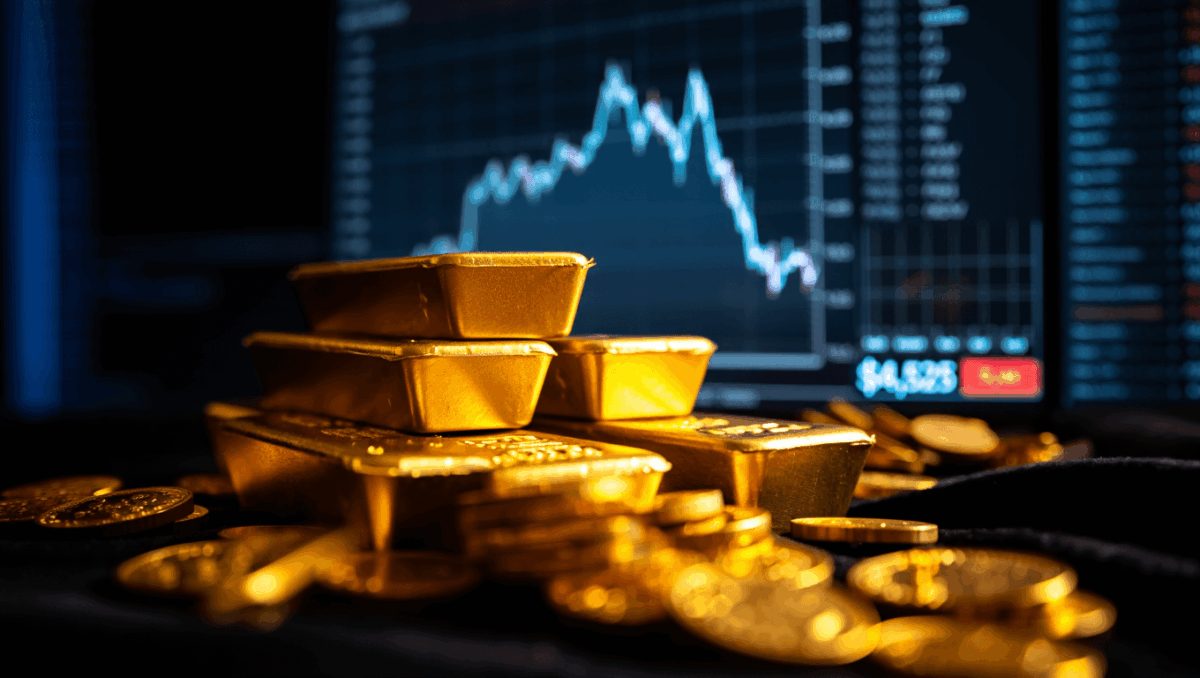
Gold price today surges to record levels as precious metal bounces near $4,525 per ounce. This marks another breathtaking milestone in 2025’s historic rally. Investors are closely watching whether gold can sustain these unprecedented peaks heading into the new year.
🔥 Quick Facts
- Gold today reached a record intraday high of $4,530.60 per ounce on December 26, 2025
- Year-to-date surge: Gold prices have climbed an extraordinary 72% in 2025, the best annual performance since 1979
- Spot gold price currently trading near $4,510-$4,525 per ounce according to major financial platforms
- Record streak: Gold achieved over 50 all-time highs throughout the year, driven by safe-haven demand and central bank purchases
Gold Hits New $4,525 Peak Amid Market Uncertainty
Intuit emerges as best software stock for 2026 while stock crashes to bargain levels analysts didn’t expect
2026 tax brackets shock Americans with hidden paycheck truth nobody expected
Gold price today showcased remarkable strength, touching a record intraday high of $4,530.60 per ounce this morning. Spot gold futures opened at $4,523.50 on Friday, demonstrating the metal’s relentless momentum heading into year-end trading.
This latest surge continues gold’s extraordinary 2025 performance. The precious metal has climbed over 72% for the year, making it one of the most compelling investments for portfolio diversification. The psychological barrier at $4,500 per ounce was finally breached this week, signaling broader institutional confidence in gold’s role as a portfolio hedge.
What’s Driving Gold’s Unprecedented 2025 Rally
Marcus Lemonis takes CEO role at Bed Bath & Beyond with $25M cost-cutting plan and watch what industry experts are saying about his next move
SPX surges 34 points at open with shocking tech recovery, here’s what caused the unexpected Venezuela rally
Multiple factors continue fueling gold’s dramatic ascent. Geopolitical tensions have intensified throughout 2025, prompting investors to seek safe-haven assets. Rising frictions in Venezuela and escalating global uncertainties have driven institutional capital toward gold.
Central banks globally are purchasing gold at record levels, signaling long-term diversification away from US dollar holdings. This de-dollarization trend represents a structural shift in global finance. Simultaneously, exchange-traded fund (ETF) inflows have surged dramatically, making gold more accessible to retail investors and amplifying demand.
Interest rate expectations remain a critical driver. Market participants anticipate potential Fed rate cuts in the coming year, making non-yielding gold more attractive relative to fixed-income alternatives. Additionally, inflation hedging concerns and tariff uncertainty from trade policy developments have reinforced gold’s appeal.
Financial Forecasts Predict Gold Targets Between $4,500-$5,000 in 2026
| Investment Bank | 2026 Forecast | Timeline |
| JP Morgan | $4,600 (Q2 average); Above $5,000 (Q4) | Throughout 2026 |
| Goldman Sachs | $4,900 per ounce | December 2026 |
| Morgan Stanley | $4,500 per ounce | Mid-2026 |
| Metals Focus | $5,000 per ounce | End of 2026 |
Major investment banks have significantly raised their gold price targets for 2026. JP Morgan forecasts gold could climb above $5,000 in Q4 2026. Goldman Sachs lifted its December 2026 target to $4,900, citing strong structural demand from Western ETFs and central banks.
The consensus view remains decidedly bullish. Nearly 70% of institutional investors expect gold prices to continue rising through 2026, with 36% believing prices will top $5,000 before year-end, according to Goldman Sachs client surveys.
“The gold rally in 2025 was driven by expectations of interest-rate cuts, geopolitical tensions, and tariffs introduced by US President Donald Trump. Gold’s 2026 outlook remains constructive.”
— Financial analysts, Multi-source consensus from major financial platforms
Central Banks and ETF Demand Continue Reshaping Gold Markets
Central bank demand has emerged as a primary structural support for gold prices. Global monetary authorities are accumulating gold reserves at unprecedented rates, signaling confidence in the metal’s long-term value. This official channel demand supplements traditional investment flows.
Exchange-traded funds tracking gold have experienced exceptional inflows throughout 2025. These instruments democratize gold investment, allowing retail portfolios to gain precious metal exposure without storing physical bullion. The accessibility benefit has expanded the investor base dramatically.
Inflation concerns, though manageable, continue supporting gold narratives. Investors view gold as an effective inflation hedge during periods of monetary expansion or policy uncertainty. The combination of safe-haven buying, central bank support, and retail ETF demand creates a powerful fundamental backdrop.
What Should Investors Watch Next in the Gold Market?
Several critical factors will determine gold’s trajectory in 2026. Federal Reserve policy decisions deserve close attention, as interest rate changes directly impact gold’s opportunity cost. Market participants will scrutinize inflation data, dollar strength, and geopolitical developments affecting risk sentiment.
The $5,000 per ounce level represents a psychological target that professional investors have begun targeting. Breaking above this threshold would require sustained institutional buying and continued safe-haven demand. Conversely, any significant pullback toward $4,300-$4,400 could provide attractive entry points for long-term investors.
Central bank policy divergence globally, particularly regarding monetary easing in major economies, will shape precious metal demand. Technical support at $4,450 and resistance at $4,600 may define trading ranges before year-end.
Sources
- Reuters – Gold record highs and precious metals market analysis
- JP Morgan – Gold price predictions and 2026 commodity forecasts
- Goldman Sachs – Gold market outlook and institutional investor surveys

Patrick Graham is a business and finance journalist translating Wall Street’s complexities into stories that matter to everyday readers. With extensive experience in financial journalism and economic analysis, this expert journalist provides sharp insights on market trends, corporate developments, and the economic forces affecting daily life. His reporting helps readers make sense of the business world’s biggest moves.