
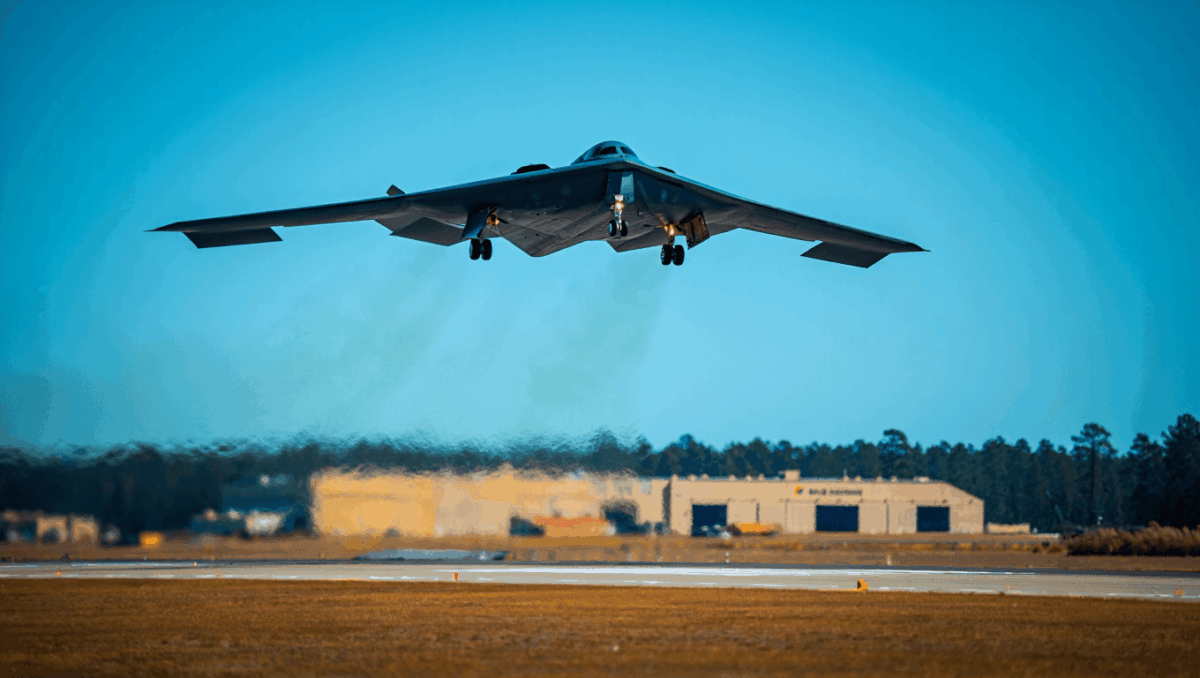
Stealth bombers are proving combat ready ahead of schedule as the B-21 Raider moves closer toward operational deployment in January 2026. Northrop Grumman is poised to secure production contracts potentially exceeding $100 billion as the Pentagon accelerates orders for this next-generation bomber platform.
🔥 Quick Facts
- The B-21 Raider is scheduled for operational readiness in 2026 or 2027, ahead of the original 2029 timeline
- Two additional test aircraft are expected to arrive in 2026 with combat-capable configurations
- Congress allocated $4.5 billion in fiscal 2026 for production expansion at Northrop Grumman plants
- The Air Force plans 100+ B-21 units as part of the next-generation bomber modernization strategy
B-21 Raider Achieves Major Development Milestone in January 2026
Intuit emerges as best software stock for 2026 while stock crashes to bargain levels analysts didn’t expect
2026 tax brackets shock Americans with hidden paycheck truth nobody expected
The B-21 Raider represents the first new American stealth bomber in more than three decades. Developed by Northrop Grumman under the Long Range Strike Bomber program initiated in 2011, the aircraft earned its public debut in December 2022 at Northrop’s production facility in Palmdale, California.
The first B-21 took flight on November 10, 2023, marking a critical step in the program’s progression. By September 2025, a second test aircraft successfully achieved flight status at Edwards Air Force Base, confirming the rapid development pace. Northrop Grumman has advanced the program on schedule despite manufacturing cost pressures.
Production Acceleration Drives $100+ Billion Opportunity for Northrop Grumman
Marcus Lemonis takes CEO role at Bed Bath & Beyond with $25M cost-cutting plan and watch what industry experts are saying about his next move
SPX surges 34 points at open with shocking tech recovery, here’s what caused the unexpected Venezuela rally
Congress included $10.3 billion in the fiscal 2026 budget for combined research, development, and production of the B-21 program. Of this amount, $4.5 billion was specifically allocated for production capacity expansion in a budget reconciliation bill passed in July 2025.
Northrop Grumman expects to receive its next formal production contract before the end of January 2026. The company is implementing digital manufacturing tools and accelerated testing protocols to double production rates in coming years. As the Pentagon pursues a fleet of 100+ aircraft valued at approximately $700 million per unit, the total long-range contract opportunity could exceed $100 billion across the full production cycle.
The Air Force is investing heavily in infrastructure upgrades at three designated B-21 main bases. Fiscal 2026 will see extensive military construction projects begin at these facilities to support initial operational squadrons.
| Metric | Value |
| Operational Service Entry | 2026-2027 (planned) |
| Total Planned Fleet Size | 100+ aircraft |
| Estimated Unit Cost | $700 million per aircraft |
| FY2026 Budget Allocation | $10.3 billion (R&D and production) |
| Production Expansion Funding | $4.5 billion |
Combat Readiness Confirmed as Test Aircraft Prepare for Operational Missions
The Air Force Chief of Staff confirmed that test aircraft can be quickly configured for combat operations if operational necessity arose. This engineering flexibility positions the B-21 as immediately deployable upon completion of current flight-test campaigns.
Second and third aircraft are undergoing comprehensive weapons and mission systems integration testing at Edwards Air Force Base. Integration efforts focus on sensors, avionics, and advanced targeting systems that will define the B-21’s operational capabilities. The program maintains concurrency between testing and production planning to accelerate entry into service.
Ellsworth Air Force Base Prepares Infrastructure for B-21 Deployment
Ellsworth AFB in South Dakota was selected in March 2019 to host the first operational B-21 unit and training squadron. Military construction projects launched in fiscal 2026 encompass facility upgrades across Ellsworth, Dyess AFB in Texas, and Whiteman AFB in Missouri.
Ellsworth is undergoing significant facility reconstruction to accommodate next-generation stealth bomber operations. The base infrastructure modernization spans more than three dozen construction projects designed to support pilot training and sustained operational deployments.
What Makes the B-21 Raider the Next Frontier in Stealth Bomber Technology?
The B-21 Raider incorporates stealth technology two generations ahead of the existing B-2 Spirit. Its design achieves extremely low observable signatures from all aspects, rather than primarily from forward angles.
The aircraft combines uncrewed collaborative systems, autonomous operations, and advanced integrated avionics into a platform built for contested airspace operations. Northrop Grumman partnered with Pratt & Whitney, Collins Aerospace, BAE Systems, and other defense contractors to develop this sixth-generation bomber concept.
Sources
- U.S. Air Force Official Release – B-21 Raider development and testing updates
- Defense News – Production contracts and fiscal 2026 budget allocations
- Northrop Grumman Corporate Announcement – Aircraft delivery and manufacturing acceleration

Patrick Graham is a business and finance journalist translating Wall Street’s complexities into stories that matter to everyday readers. With extensive experience in financial journalism and economic analysis, this expert journalist provides sharp insights on market trends, corporate developments, and the economic forces affecting daily life. His reporting helps readers make sense of the business world’s biggest moves.