
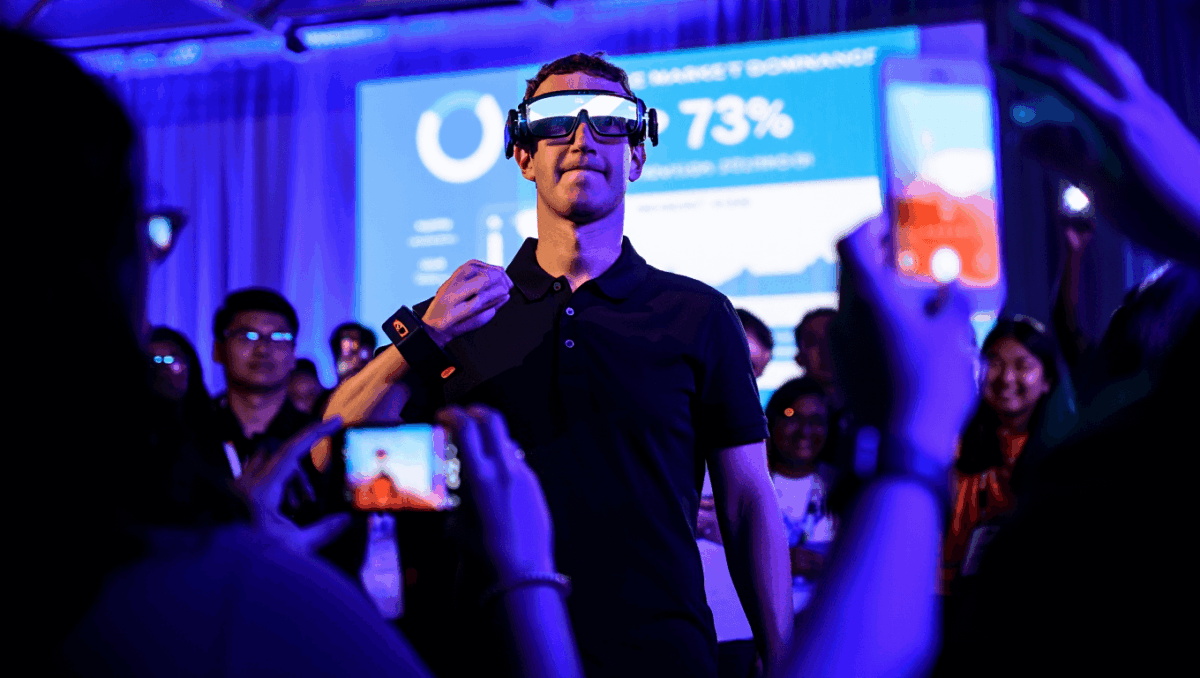
Meta dominates the booming AI glasses market with a commanding 73% market share in the first half of 2025, positioning the tech giant for record-breaking stock performance heading into 2026. With over 2 million Ray-Ban Meta smart glasses sold and an all-time stock high of $796.25 in August, Meta’s wearables division has become a major growth engine. Analysts predict Meta stock could reach new record highs above $900 in 2026 as the company scales production and launches advanced glasses with integrated displays.
🔥 Quick Facts
- Meta controls 73% of the smart glasses market as of H1 2025, up from 46% the previous year
- Ray-Ban Meta sales tripled in Q2 2025, with total sales reaching 2+ million units since launch
- Meta Ray-Ban Display glasses launched September 30, 2025 at $799, featuring AI integration and neural wristband control
- EssilorLuxottica plans 10 million annual units by end of 2026, scaling production to meet surging demand
Meta’s Unbeatable Position in AI Glasses Leadership
Intuit emerges as best software stock for 2026 while stock crashes to bargain levels analysts didn’t expect
2026 tax brackets shock Americans with hidden paycheck truth nobody expected
Meta’s dominance in the smart glasses market has become unmistakable. According to Counterpoint Research, the company captured 73% market share in H1 2025, an impressive jump from 46% in H1 2024. This commanding lead reflects the success of the Ray-Ban Meta collaboration, which has become the gold standard for wearable AI technology.
The global smart glasses market grew 110% year-over-year in the first half of 2025, with AI-enabled glasses accounting for 78% of total shipments. Meta’s ability to combine high-end AI capabilities with the iconic Ray-Ban brand has created an unmatched competitive advantage. Chinese competitors like Xiaomi and Huawei are attempting to challenge Meta’s position, but their market share remains negligible compared to Meta’s dominance.
Marcus Lemonis takes CEO role at Bed Bath & Beyond with $25M cost-cutting plan and watch what industry experts are saying about his next move
SPX surges 34 points at open with shocking tech recovery, here’s what caused the unexpected Venezuela rally
Industry analysts emphasize that Meta’s success goes beyond just hardware. The company has invested heavily in software ecosystems, social integration, and practical AI applications that make these glasses genuinely useful rather than novelty items.
Record-Breaking Sales and Production Scaling
Ray-Ban Meta smart glasses sales have tripled during 2025, reflecting explosive consumer demand. The partnership between Meta and EssilorLuxottica (Ray-Ban’s parent company) has proven highly successful, with over 2 million units sold since the original launch in September 2023. In Q2 2025 alone, sales tripled, helping drive Meta’s 22% year-over-year revenue growth.
Production capacity has emerged as the critical bottleneck. EssilorLuxottica announced plans to reach 10 million annual production units by the end of 2026, a dramatic scaling operation that signals confidence in sustained demand. The company accelerated these timelines in October 2025, indicating it could hit these targets ahead of schedule. Ray-Ban Gen 2 models now retail for $379 to $499, providing entry-level options alongside the premium offerings.
| Product | Price | Launch Date |
| Ray-Ban Meta Display | $799 (includes Neural Band) | September 30, 2025 |
| Ray-Ban Meta Gen 2 | $379 | Available Now |
| Oakley Meta Vanguard | $499 | October 2025 |
| Global Market Share | 73% (H1 2025) | Current |
Meta Stock Aiming for New All-Time Highs in 2026
Meta’s impressive wearables momentum directly translates to stock market optimism. The company’s share price hit an all-time closing high of $788.82 on August 12, 2025, with intraday highs reaching $796.25. After declining modestly from those peaks, analysts across major financial institutions have become increasingly bullish on Meta stock reaching new record highs above $900 in 2026.
Baird analysts labeled Meta stock a “buy” despite acknowledging negative sentiment lingering into 2026. Multiple analyst price targets suggest potential upside to $1,117 per share, implying significant gains from current levels. The core investment thesis centers on Meta’s dominance in AI hardware, strong advertising momentum, and the transformative potential of the AI glasses category itself.
For 2025, Meta expects Q4 revenue between $56-59 billion, implying 19% year-over-year growth at the midpoint. However, analysts warn about increased capital expenditures approaching $100+ billion in 2026 as Meta invests heavily in AI infrastructure and scaling manufacturing capacity for wearables.
Why 2026 Will Be the Decisive Year for AI Glasses Mainstream Adoption
The launch of Meta Ray-Ban Display glasses in September 2025 represents a watershed moment for the entire AI wearables category. Unlike previous generations that displayed information through transparent lenses, these new glasses feature a small integrated digital display controlled through a neural wristband. This breakthrough technology finally realizes the vision of practical augmented reality in everyday eyewear.
Industry forecasts project 10 million AI glasses units shipped globally in 2026, up from approximately 5 million in 2025. Meta’s ability to maintain 70%-73% market share in this expanding market would translate to dominating 7 million of the 10 million units. With production capacity scaling to support this volume, Meta appears positioned to capture the lion’s share of growth in a market analysts believe could reach 13-15 million units by 2027.
The strategic importance of achieving mainstream AI glasses adoption cannot be overstated. Unlike smartphones or social media, wearable AI could become the primary interface through which consumers interact with technology, making Meta’s dominance in this space invaluable for future relevance and revenue.
What happens if Meta maintains its 73% market share throughout 2026?
If Meta maintains its dominant 73% market position while the overall smart glasses market reaches 10+ million units, the company would ship 7-9 million Ray-Ban and Oakley branded glasses. At an average selling price of $400-$600 per unit (accounting for mix of entry-level and premium models), this revenue stream alone could exceed $3-5 billion annually from glasses sales, a category that barely existed three years ago.
From an investor perspective, the combination of strong advertising revenue, continued AI infrastructure investments, and explosive wearables growth creates a compelling bull case for 2026. Analysts predicting Meta stock reaching $900+ cite the company’s ability to monetize AI glasses through both direct hardware sales and data-driven advertising targeting powered by camera and sensor inputs.
The critical risk factors include regulatory scrutiny over privacy and data collection, manufacturing delays in ramping to 10 million units, and unexpected competition from larger players like Apple entering the market. However, Meta’s 18-month head start in consumer adoption and production scaling provides substantial protection against these risks.
Sources
- Counterpoint Research – Global smart glasses market analysis and Meta market share data
- Reuters and CNBC – EssilorLuxottica production capacity targets and earnings announcements
- Financial analysts – Meta stock price targets and 2026 forecasts

Patrick Graham is a business and finance journalist translating Wall Street’s complexities into stories that matter to everyday readers. With extensive experience in financial journalism and economic analysis, this expert journalist provides sharp insights on market trends, corporate developments, and the economic forces affecting daily life. His reporting helps readers make sense of the business world’s biggest moves.