
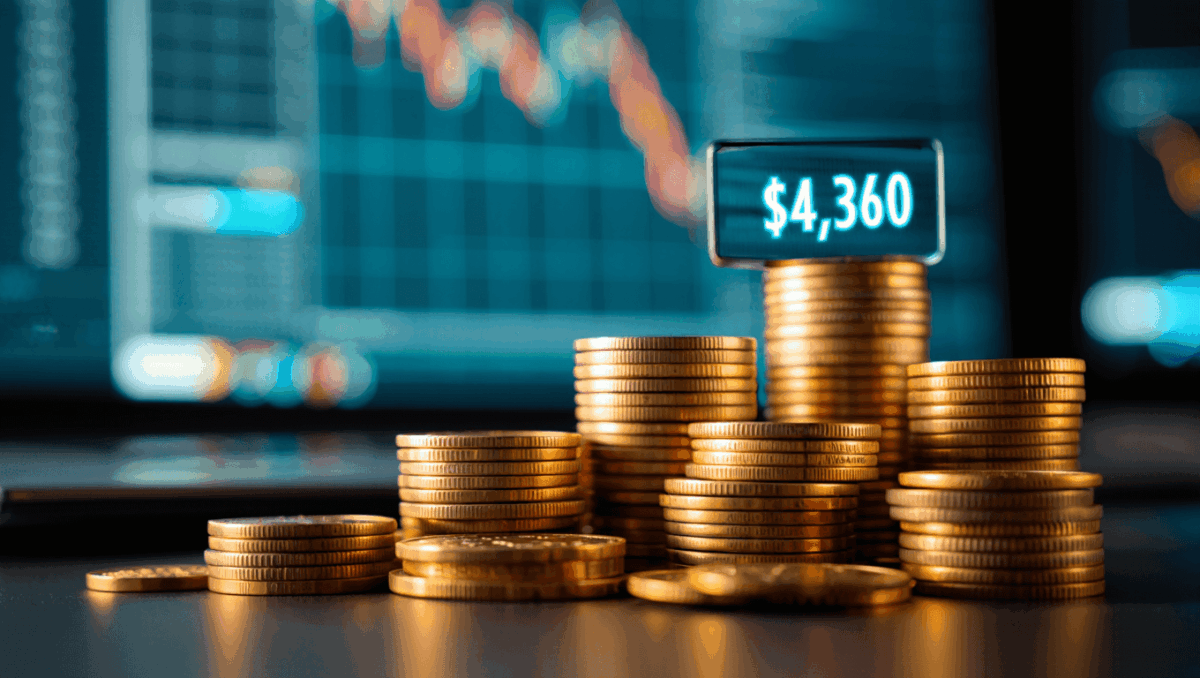
Gold prices reached $4,360 per ounce as markets kicked off 2026 on a strong footing. The precious metal extends its record-breaking rally from 2025, continuing gains that have defined the start of the year. Both retail investors and major financial institutions are watching closely to see how high the metal can climb in 2026.
🔥 Quick Facts
- Gold rose to $4,331 on January 2, 2026, up 0.26% from the previous day
- The metal gained 66% in 2025, marking its strongest annual performance since 1979
- Central banks purchased 53 tonnes in October 2025 alone, a 36% monthly increase
- 71% of retail investors expect gold to trade above $5,000 per ounce during 2026
Gold Rallies Past $4,360 as 2026 Trading Begins
Intuit emerges as best software stock for 2026 while stock crashes to bargain levels analysts didn’t expect
2026 tax brackets shock Americans with hidden paycheck truth nobody expected
Spot gold opened 2026 near $4,313 per ounce, briefly reaching $4,402 earlier in the session as safe-haven demand and investment appetite strengthened markets. The momentum from 2025’s historic rally has carried directly into the new year. Trading activity accelerated as investors positioned themselves for continued upside movement.
The precious metal benefited from rate cut expectations and a broadly cautious market sentiment among global investors. Analysts note that positive momentum is particularly strong in early January trading. Technical support levels around $4,280 held firm throughout the session, while resistance emerged near $4,450.
2025’s Extraordinary 66% Gain Reshapes Investment Landscape
Marcus Lemonis takes CEO role at Bed Bath & Beyond with $25M cost-cutting plan and watch what industry experts are saying about his next move
SPX surges 34 points at open with shocking tech recovery, here’s what caused the unexpected Venezuela rally
Gold’s 66% rally in 2025 represents its strongest annual performance since 1979, according to multiple sources. From an opening price of $2,606 in early January 2025, the metal surged to near-record levels by year-end. This outperformance exceeded analyst consensus by 25.6%, catching many market participants by surprise.
Silver jumped even more dramatically, gaining 142% for the year, while gold’s rise established it as a defensive hedge against economic uncertainty. The rally was fueled by geopolitical risks, shifting inflation dynamics, and Federal Reserve policy shifts. December saw the metal reach $4,795 before year-end profit-taking brought prices down slightly.
Central Banks and Investors Continue Massive Gold Accumulation
table style=’width:100%;border-collapse:collapse;margin:20px 0′>
Central bank gold buying remains a primary driver of prices heading into 2026. JP Morgan expects central and investor demand to average 585 tonnes per quarter throughout 2026. The World Gold Council reported that Q3 2025 demand hit 1,313 tonnes, the strongest quarterly total ever recorded.
Goldman Sachs forecasts central bank purchases averaging 70 tonnes monthly in 2026, close to recent averages but suggesting sustained accumulation. Multiple analysts confirm that central banks are still acquiring gold aggressively with no obvious signals this trend will break. Lower real yields and persistent global economic uncertainty support continued institutional demand.
Bank Forecasts and Investor Sentiment Point Toward $5,000
Price targets for 2026 vary widely among major financial institutions. JP Morgan expects gold to push toward $5,000 by Q4 2026, while Bank of America strategist Michael Widner predicts an even more optimistic outcome. RBC Capital Markets maintains a base-case target of $4,427 but sees bullish scenarios reaching $5,108.
Retail investor sentiment is particularly bullish—71% of retail traders expect gold to trade above $5,000 per ounce during 2026. However, analyst consensus suggests 2026 gains may not match 2025’s explosive 66% rally. Amundi targets $4,200 for the year, suggesting consolidation after the extraordinary 2025 performance rather than continued acceleration.
What Market Drivers Could Impact Gold Prices Throughout 2026?
Multiple factors shape the gold outlook for the year ahead. Federal Reserve interest rate decisions remain critical, as lower rates typically support higher gold prices. Geopolitical risks continue elevated globally, providing a safety-net premium for bullion. Inflation expectations and declining real yields favor gold as investors seek assets that protect purchasing power.
Currency movements, particularly the strength of the US dollar, will influence international demand and pricing. Government spending levels and structural inflation concerns persist despite moderating headline inflation. Technical analysis suggests support holds near $4,280 while major resistance appears at $4,400-$4,500, meaning early 2026 trading will establish crucial levels for the full year ahead.
Sources
- Reuters — Precious metals market reports and gold price data
- CNBC — Real-time trading updates and financial analysis
- Trading Economics — Historical gold price data and technical analysis

Patrick Graham is a business and finance journalist translating Wall Street’s complexities into stories that matter to everyday readers. With extensive experience in financial journalism and economic analysis, this expert journalist provides sharp insights on market trends, corporate developments, and the economic forces affecting daily life. His reporting helps readers make sense of the business world’s biggest moves.