
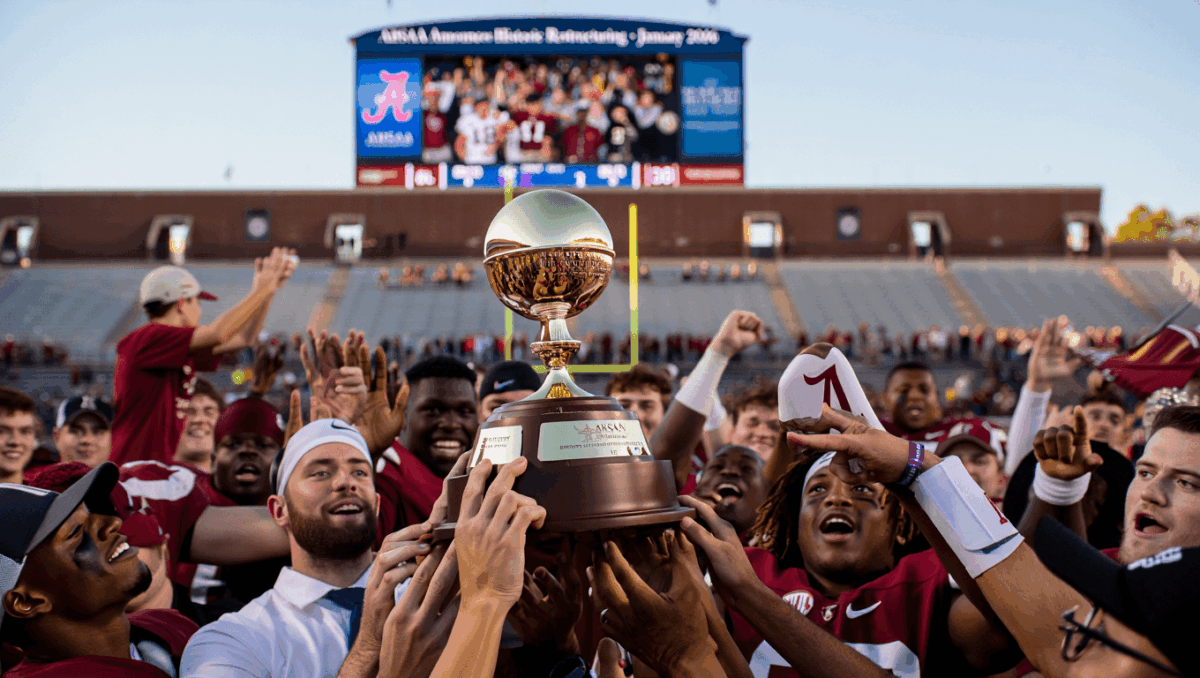
Alabama high school football just experienced its most historic restructuring in 104 years. On January 23, 2026, the AHSAA Central Board voted 13-2 to completely separate public and private schools for playoff championships beginning fall 2026. This landmark decision transforms how championships work, creating new pathways for both school types.
🔥 Quick Facts
- Historic Vote: 13-2 approval ends 104 years of unified championships
- Timeline: New structure begins fall 2026 through 2027-28 school years
- Public Classes: Six divisions, 6A has 32 teams, down from seven classes
- Private Schools: Split into Double A (17 teams) and Single A (43 teams)
A Seismic Shift for Alabama Football
Cagliari faces Lecce tonight in Serie A showdown, Rossoblu seek top-half push
Girona faces Barcelona tonight in La Liga showdown, Barcelona chases lead
The Alabama High School Athletic Association officially transformed high school athletics with this momentous decision. Board president Terry Curtis and Blount principal Jerome Woods cast the only opposing votes Friday morning. AHSAA executive director Heath Harmon emphasized this is not a separation but a restructuring of championship pathways. Public and private schools will still compete during regular season play, maintaining the competitive landscape Alabama families know.
This decision comes after the Association spent seven hours in a work session Thursday reviewing scenarios and input from members. The overwhelming support signals confidence in the new model. Since 2014, Alabama had used seven classifications for all schools combined. The new framework dramatically simplifies this approach while creating dedicated championship tracks for each school type.
How the New Structure Works
East Texas A&M faces Southeastern in Family Fun Day matchup today
Macclesfield faces Brentford tonight in FA Cup fourth-round showdown
Under the restructuring, public schools now compete in six distinct football classifications. The largest class, 6A, features exactly 32 teams competing for the state championship. Classes 5A and 4A each contain between 64-66 teams, while smaller classifications maintain 65-69 schools per tier. This distribution ensures competitive balance where enrollment actually determines placement. Private schools transition into a two-tier system: the Private Class Double A includes 17 larger schools, while Private Class Single A comprises 43 smaller institutions.
Gone are the previous multipliers and competitive balance adjustments that elevated private school classifications. These mechanisms inflated private school placement by 1.35 times per student, artificially pushing them up divisions. The removal levels the competitive field and reflects actual enrollment numbers rather than historical success metrics. Harmon called this a shift toward expanded opportunities, not elimination.
Championship Track Record and Impact
| Era | Private School Champions | Time Period |
| First 46 years | 12 titles | 1980-2026 |
| Last 14 years | 20 titles | 2012-2026 |
The data tells a compelling story. Private schools won only 12 championships in AHSAA‘s first 46 years of playoff football. However, in the past 14 years, private schools captured 20 state titles. This dramatic surge reflects how multipliers and competitive balance adjusted classifications. Board vice president Kim Kiel emphasized the Board’s confidence in the new direction after extensive scenario planning. She stated, “Change is all in what you make of it,” signaling belief in the restructured system.
The CHOOSE Act and Classification Timing
This announcement comes less than a month after AHSAA faced mediation surrounding the 2024 CHOOSE Act. The legislation allows $7,000 educational grants for private school transfers, raising questions about athletic eligibility. The Central Board originally planned to release reclassification in December but delayed due to these implications. AHSAA ultimately determined that separating championships cleanly removes these complications. Removing the multiplier and competitive balance eliminates gray areas that plagued recent seasons.
Curtis, who coached 26 years at UMS-Wright‘s head post, expressed concern publicly. He acknowledged voting his conscience despite the majority support. His worry centers on whether public and private schools will maintain regular season matchups without the earlier structural incentives. However, AHSAA reasserted that nothing prevents cross-school play outside playoffs, only championship brackets.
What This Means for Alabama High School Football
This restructuring represents a fundamental reimagining of an organization founded in 1922. The AHSAA reclassifies every two years based on average daily membership from grades 9-11 plus retained eighth-graders. Without multipliers distorting numbers, classification becomes purely enrollment-based. Harmon stated the educational landscape is changing and the Association must adapt, delivering expanded championship opportunities rather than creating divisions. The Board will likely release winter and spring sport alignments next month, with similar public-private separation. What questions remain about implementation, regional alignment, and playoff scheduling?
Sources
- AL.com – Ben Thomas and Thomas Ashworth reported the complete AHSAA restructuring vote and classification details
- AHSAA Official – Executive Director Heath Harmon provided official commentary on the historic decision
- Montgomery Advertiser – Covered the Board’s official announcement and immediate reactions to the change

Michael Brown is a seasoned sports journalist bringing years of experience covering professional athletics and sporting culture. With a keen eye for breaking stories and player dynamics, this veteran journalist delivers in-depth analysis and exclusive insights from the world’s biggest sporting events. His passion for the game shines through in every story, keeping fans connected to the action both on and off the field.