
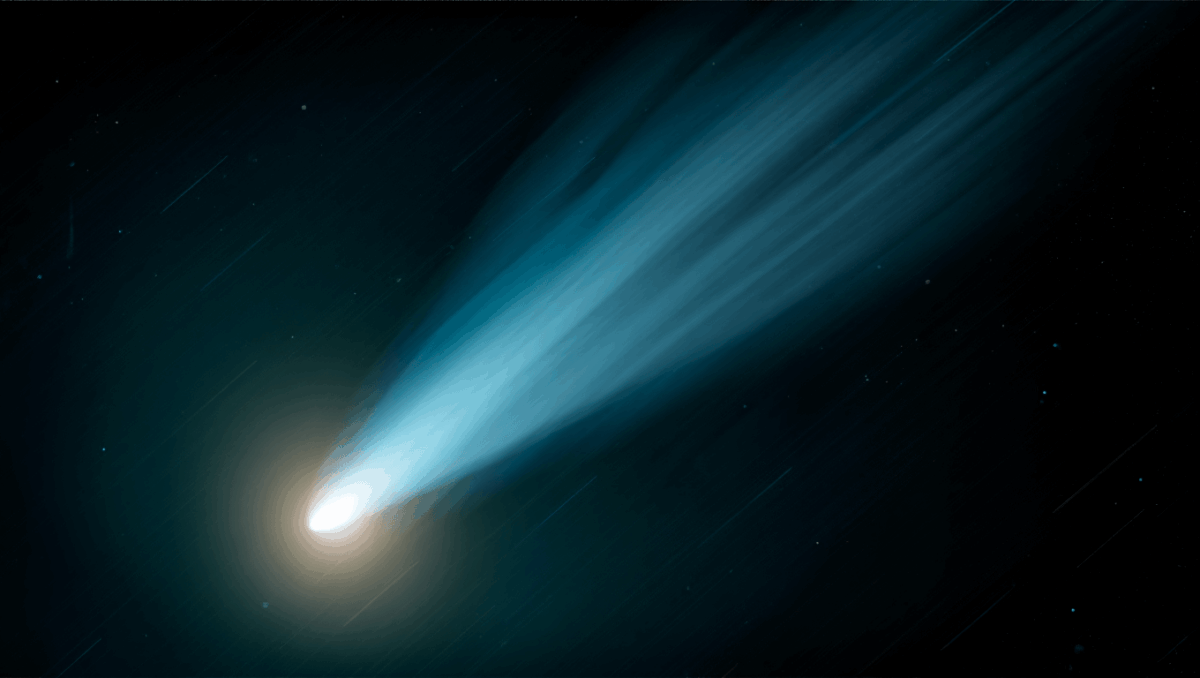
Astronomers tracking the NASA interstellar comet 3I ATLAS are witnessing unprecedented chemical activity from this ancient cosmic visitor. The Hubble Space Telescope captured new images on November 30 revealing the comet is releasing remarkable quantities of methanol, cyanide, and carbon dioxide—the building blocks of life itself. Before the comet makes its closest Earth approach on December 19, scientists are racing to understand what these organic compounds tell us about the origins of life in the universe.
🔥 Quick Facts
- The interstellar comet 3I ATLAS will reach its closest point to Earth on December 19, 2025, at 1.8 AU distance (268 million kilometers)
- NASA’s Hubble Space Telescope observed the comet on November 30 using its Wide Field Camera 3 instrument
- Astronomers detected methanol, hydrogen cyanide, and carbon dioxide—molecules essential for the chemistry of life
- The comet releases approximately 20 grams per second of cyanide, an unusually high rate compared to typical solar system comets
What Makes This Interstellar Comet So Extraordinary
Intuit emerges as best software stock for 2026 while stock crashes to bargain levels analysts didn’t expect
2026 tax brackets shock Americans with hidden paycheck truth nobody expected
The 3I ATLAS comet represents something astronomers rarely see: a visitor from outside our solar system carrying the molecular building blocks necessary for life. Unlike typical solar system comets that originated with our sun, this interstellar wanderer originated billions of miles away in a distant star system. The comet was first detected on July 1, 2025 by the Asteroid Terrestrial-impact Last Alert System telescope in Chile.
What sets 3I ATLAS apart is not just its extraterrestrial origin but its staggering chemical activity. Scientists detected carbon dioxide, methanol, hydrogen cyanide, and even nickel in measurements taken using ground and space-based observatories across multiple missions. This composition suggests the comet spent billions of years traveling through interstellar space before encountering our sun.
Hubble’s Latest Breakthrough Discovery on Life-Building Chemistry
Marcus Lemonis takes CEO role at Bed Bath & Beyond with $25M cost-cutting plan and watch what industry experts are saying about his next move
SPX surges 34 points at open with shocking tech recovery, here’s what caused the unexpected Venezuela rally
The Hubble Space Telescope’s observation on November 30, 2025 captured crucial details about the comet’s chemical signature. Using the Wide Field Camera 3, astronomers photographed the bright nucleus surrounded by an active coma—the glowing envelope of gas and dust. The image revealed an extraordinarily bright core, suggesting intense outgassing from the icy nucleus as the comet approaches its perihelion point.
Methanol, a simple carbon-based compound, acts as a crucial foundation for more complex organic molecules associated with life’s origins. The comet releases methanol at rates that astronomers consider exceptionally elevated compared to most comets studied in our solar system. At the same time, detection of hydrogen cyanide and cyanide compounds provides further evidence of the complex organic chemistry occurring within this cosmic object.
| Chemical Compound | Significance |
| Methanol (CH₃OH) | Building block for amino acids and nucleotides linked to life |
| Hydrogen Cyanide (HCN) | Precursor molecule for key organic compounds |
| Carbon Dioxide (CO₂) | Essential component of organic chemistry and atmospheric chemistry |
| Cyanide (CN) | Detected at mass loss rate of approximately 20 grams per second |
How This Discovery Reshapes Our Understanding of Cosmic Origins
The detection of these organic compounds in an interstellar comet fundamentally challenges long-held assumptions about how life’s building blocks form and spread throughout the galaxy. For decades, astronomers theorized that comets delivered water and organic materials to early Earth, jump-starting biochemistry in our oceans. However, discovering these same chemicals in a comet arriving from outside our solar system suggests they may be common throughout interstellar space.
The abundance of carbon-based molecules in 3I ATLAS indicates that complex organic chemistry flourishes in the cold regions between stars, where temperatures plunge to near absolute zero. These conditions prove far more capable of preserving and producing life-building compounds than scientists previously believed. If such molecules exist throughout the galaxy in such quantities, the implications for the prevalence of life-bearing chemistry across the cosmos cannot be overstated.
The observation of nickel and unusual color variations in 3I ATLAS adds another layer of complexity. Multiple missions tracked color changes, with the comet appearing bluer than typical solar system comets, suggesting distinct mineral and chemical compositions shaped by its journey through interstellar space.
A Countdown to December 19: What Happens When the Cosmic Visitor Makes Its Closest Approach
The NASA interstellar comet 3I ATLAS reaches its closest point to Earth on December 19, 2025, arriving at a safe distance of 1.8 astronomical units—further away than Mars typically orbits. Despite remaining invisible to the naked eye, the comet will reach visual magnitude 14.93, making it observable through telescopes. Ground-based observatories will capture unprecedented detail of this ancient visitor during this final approach window.
Scientists plan intensive observations during this period to gather additional spectroscopic data about the comet’s composition and activity levels. Every measurement counts, as this represents humanity’s single best opportunity to study an interstellar object from our solar system’s perspective. After December 19, the comet will gradually recede back into the cosmic void, eventually leaving our solar system entirely and returning to the infinite darkness of interstellar space.
Why Should Non-Astronomers Care About an Invisible Comet Passing Overhead?
The significance of 3I ATLAS extends far beyond academic interest or professional astronomy circles. This comet carries evidence suggesting that the raw materials necessary for life are not unique to our corner of the universe but distributed throughout the galaxy as standard components of interstellar matter. If billions of comets like 3I ATLAS exist throughout the Milky Way, each carrying methanol and organic compounds, the statistical probability of life existing elsewhere becomes profoundly higher.
Additionally, understanding how organic chemistry operates in interstellar comets helps scientists refine models of how life emerged on early Earth. If comets delivered not just water but entire libraries of pre-formed organic molecules, the puzzle of life’s origins becomes somewhat less mysterious. Business and financial institutions tracking space exploration investments monitor these discoveries closely, as they influence funding priorities for future space missions and asteroid-mining initiatives that could potentially capture resource-rich comets in coming centuries.

Patrick Graham is a business and finance journalist translating Wall Street’s complexities into stories that matter to everyday readers. With extensive experience in financial journalism and economic analysis, this expert journalist provides sharp insights on market trends, corporate developments, and the economic forces affecting daily life. His reporting helps readers make sense of the business world’s biggest moves.