
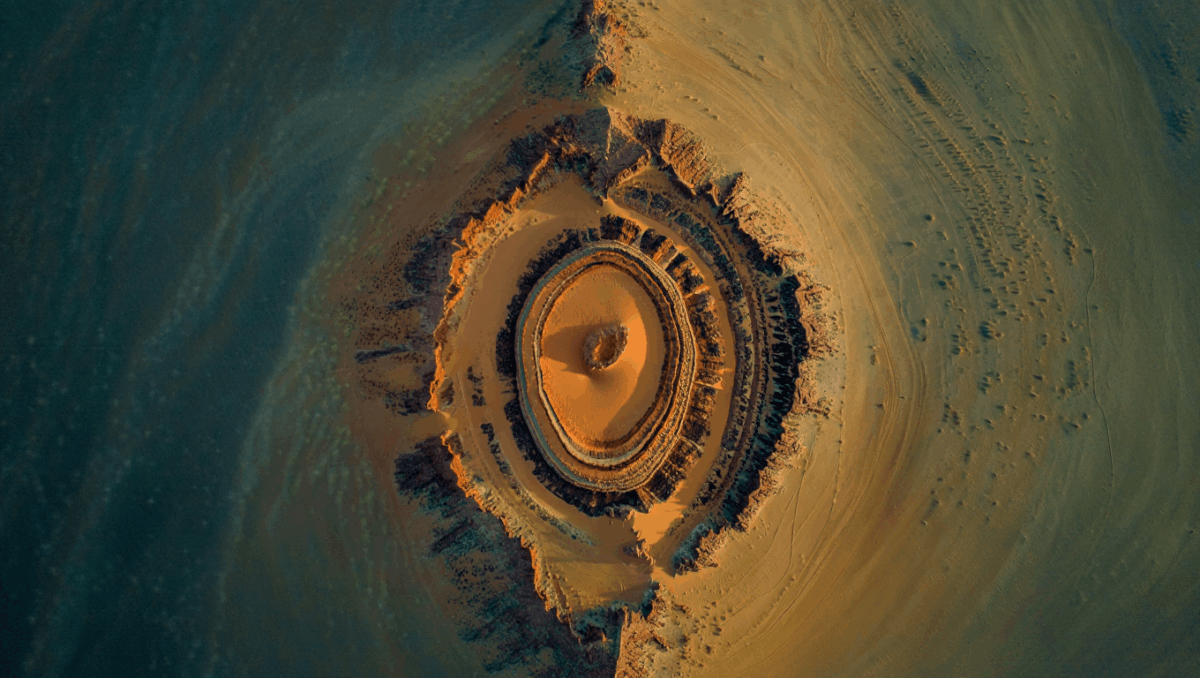
NASA Earth Observatory continues revealing Earth’s most stunning geological wonders from space. Northwestern Mauritania harbors one of the planet’s most mesmerizing natural formations—a circular structure spanning 40 kilometers that astronauts regularly photograph from the International Space Station. Scientists now confirm this ancient geological marvel was shaped by forces that began working tens of millions of years ago.
🔥 Quick Facts
- The Eye of the Sahara measures approximately 40 kilometers (25 miles) in diameter
- Geologists confirm the structure is at least 100 million years old, dating to the Cretaceous period
- Once mistaken for a meteor impact crater, it actually formed through tectonic uplift and erosion
- The Richat Structure remains one of the most photographed geological features visible from space
The Eye of the Sahara Takes Shape Over Millions of Years
America’s Next Top Model documentary drops today on Netflix with shocking revelations
Dana Eden dies at 52, Tehran producer found dead in Athens hotel
This remarkable formation didn’t appear overnight. During the mid-Cretaceous period, roughly 100 million years ago, the Adrar plateau experienced significant geological upheaval. A massive subsurface igneous intrusion began pushing upward through layers of sedimentary rock, creating an enormous dome. Over countless millennia, wind, water, and weathering gradually eroded this dome’s outer layers, revealing spectacular concentric rings of rock.
The layered structure visible from space today tells a geological story spanning hundreds of millions of years. Rock formations at the outer rings date to approximately 100 million years ago, while some innermost layers reach back nearly 500 million years. Each ring represents distinct geological periods, preserved like a natural archive of Earth’s surface.
Satellite Technology Reveals Hidden Geological Details
| Geographic Feature | Details |
| Location | Northwestern Mauritania, Adrar Plateau |
| Diameter | 40 kilometers (25 miles) |
| Age | At least 100 million years (Cretaceous period) |
| Formation Type | Eroded geological dome from volcanic activity |
| Rock Composition | Sedimentary and volcanic layers |
Tommy Lee Jones’ daughter was pregnant before her tragic death, court docs reveal
J Cole announces The Fall-Off world tour, first global dates in decades
Recent satellite imagery from the Copernicus Sentinel-2 mission and NASA astronaut photographs captured from the International Space Station showcase the formation’s incredible detail. The concentric ring pattern becomes unmistakable from orbit, with each band representing different rock types and ages. Enhanced imaging techniques using infrared and shortwave wavelengths reveal compositional variations invisible to the human eye.
Why Scientists Initially Mistook It for an Impact Crater
The circular symmetry and bull’s-eye appearance naturally led early researchers to hypothesize that the Eye of the Sahara resulted from a massive meteorite impact. The perfectly concentric rings seemed to support this theory. However, detailed geological studies eventually proved otherwise, revealing the true cause was internal geological forces rather than external cosmic collision.
The structure’s resemblance to impact craters explains why it captured scientific attention for decades. Ground-based surveys and drilling expeditions finally provided the definitive answer—the formation’s rock layers show no evidence of the violent shock deformation typical of meteor impacts. Instead, they display the characteristics of tectonic uplift followed by millions of years of patient erosion.
From Ancient Wonder to Modern Natural Monument
Today, NASA Earth Observatory regularly features the Richat Structure in its publications, highlighting this formation as a masterpiece of planetary geology. The feature has attracted astronauts since the earliest space missions, earning its nickname the ‘Eye of Africa’ or ‘Eye of the Sahara’ among space professionals. Satellite missions have documented this formation’s appearance across decades, creating a unique archive of geological change.
Scientists continue studying this ancient wonder to understand the complex processes of tectonic activity, erosion patterns, and the long-term evolution of continental platforms. The Richat Structure serves as a natural laboratory for understanding how Earth’s surface transforms across geological timescales. For explorers and researchers, the site remains relatively remote but increasingly accessible through satellite data and occasional ground expeditions.
Why This Ancient Geological Formation Captivates Space Observers Worldwide?
The Eye of the Sahara represents far more than an unusual rock formation. It embodies Earth’s dynamic geology and the vast timescales on which planetary transformation occurs. The perfect visibility from space, combined with its mysterious origins and striking symmetry, creates an iconic natural landmark that fascinates scientists, astronauts, and Earth observation enthusiasts alike.
Recent satellite imagery has sparked renewed interest in this Mauritanian wonder. Educational institutions worldwide feature the formation in geology courses. The concentric rings provide tangible evidence of geological processes normally invisible during human lifespans. When astronauts photograph the structure from the International Space Station, they’re capturing an authentic record of Earth’s restless surface and the patient artistry of geological time.
Sources
- NASA Earth Observatory – Richat Structure satellite images and geological analysis
- European Space Agency (ESA) – Copernicus Sentinel-2 imagery and recent documentation
- U.S. Geological Survey (USGS) – Structural analysis and geological formation details

Jessica Morrison is a seasoned entertainment writer with over a decade of experience covering television, film, and pop culture. After earning a degree in journalism from New York University, she worked as a freelance writer for various entertainment magazines before joining red94.net. Her expertise lies in analyzing television series, from groundbreaking dramas to light-hearted comedies, and she often provides in-depth reviews and industry insights. Outside of writing, Jessica is an avid film buff and enjoys discovering new indie movies at local festivals.