
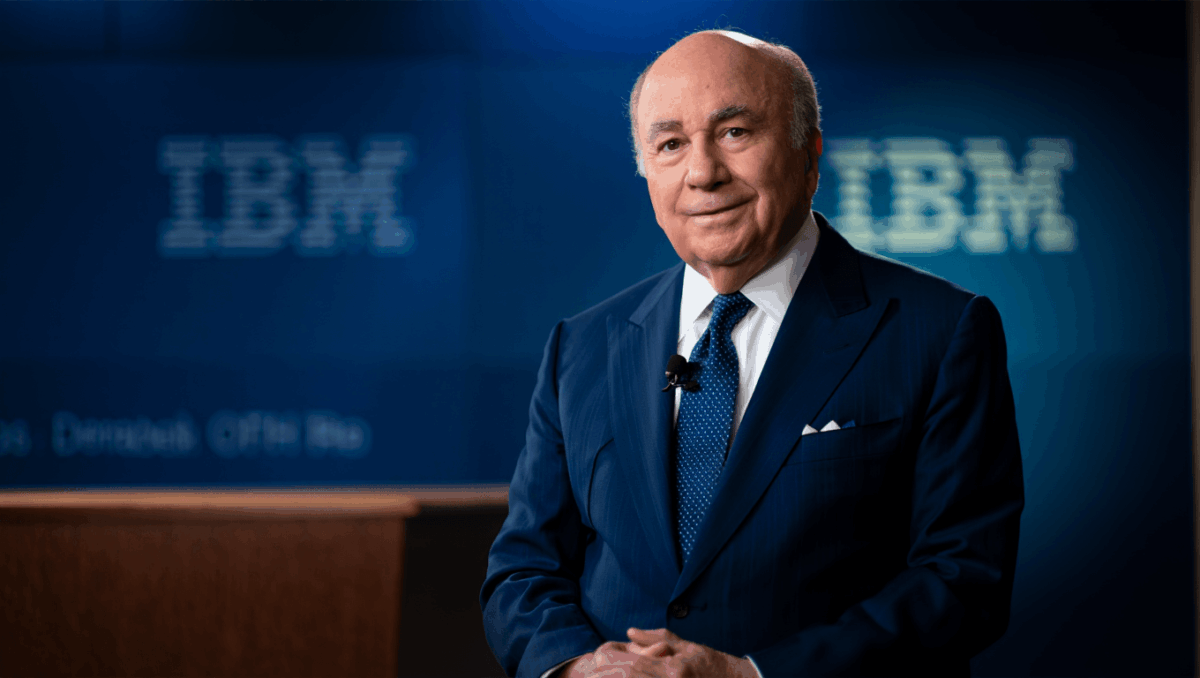
Lou Gerstner, the legendary businessman who restored IBM from near extinction in the 1990s, died on December 27, 2025, at age 83. The iconic CEO transformed the struggling technology giant into a services-oriented powerhouse, fundamentally reshaping corporate America’s approach to turnaround strategy.
🔥 Quick Facts
- Tenure at IBM: April 1993 to March 2002, then chairman until December 2002
- Career path: Former CEO of McKinsey & Co., American Express (11 years), and RJR Nabisco (4 years)
- IBM achievement: Restored company to $4.2 billion net profit within 2 years of taking over
- Leadership legacy: Shifted IBM from hardware manufacturer to enterprise services and consulting leader
The Man Who Saved Big Blue
Intuit emerges as best software stock for 2026 while stock crashes to bargain levels analysts didn’t expect
2026 tax brackets shock Americans with hidden paycheck truth nobody expected
When Lou Gerstner arrived at IBM in April 1993, few believed the company could survive. Many industry analysts advocated breaking it up and selling it for parts. IBM was losing money rapidly, its stock was plummeting, and the technology landscape was shifting away from mainframe computers toward personal computers and open systems.
Gerstner, who earned a bachelor’s degree in engineering from Dartmouth College in 1963 and an MBA from Harvard Business School in 1965, brought no technology background to IBM. Instead, he brought operational expertise gained from McKinsey, American Express, and RJR Nabisco. This outsider perspective proved to be exactly what IBM needed.
Marcus Lemonis takes CEO role at Bed Bath & Beyond with $25M cost-cutting plan and watch what industry experts are saying about his next move
SPX surges 34 points at open with shocking tech recovery, here’s what caused the unexpected Venezuela rally
Within two years of taking charge, Gerstner had transformed IBM’s financial trajectory, generating a $4.2 billion net profit. He accomplished this through aggressive cost-cutting, strategic restructuring, and a fundamental pivot in the company’s business model.
Transforming a Technology Icon
Gerstner’s most significant decision was preventing IBM’s breakup and instead keeping the company unified. He recognized that IBM’s true competitive advantage was its unique ability to integrate complex technologies and provide enterprise-wide solutions to major corporations—not in building individual products.
His strategic vision involved three major shifts: first, repositioning IBM away from hardware manufacturing toward services and consulting; second, restructuring the compensation system so that employee rewards were based on total corporate performance rather than individual division performance; and third, committing IBM to open industry standards.
By focusing on enterprise services, consulting, and customer-focused solutions, Gerstner transformed IBM from a “potential dinosaur into a dancing pachyderm,” as described in corporate literature celebrating the turnaround. The company shifted from being perceived as outdated to becoming an industry leader in business services and technological solutions.
| Period | IBM Status |
| Pre-1993 | Near bankruptcy, massive losses, calls for breakup |
| 1993-1995 | Rapid restructuring, return to profitability |
| 1995-2002 | Industry leader in services and consulting |
| Post-2002 | Gerstner’s strategic foundation continues to guide company |
A Life Beyond IBM
Before joining IBM, Gerstner spent 13 years at McKinsey & Company, where he became a director and learned the consulting business from the ground up. He then moved to American Express, where he served as president and chairman for 11 years, building his reputation as a transformational business leader.
At RJR Nabisco, Gerstner served as chairman and CEO for four years after the company’s leveraged buyout by Kohlberg Kravis Roberts & Co. in 1989. This role further demonstrated his ability to restructure complex organizations and make difficult strategic decisions. After retiring from IBM in December 2002, Gerstner served as chairman of The Carlyle Group from 2003 to 2008.
Beyond his corporate roles, Gerstner became a prominent voice on leadership and organizational change. He authored “Who Says Elephants Can’t Dance? Inside IBM’s Historic Turnaround,” his memoir describing how he led IBM’s extraordinary transformation from a dying company to a thriving industry leader of the computer age.
Industry Reactions and Legacy
IBM chairman and CEO Arvind Krishna announced Gerstner’s death in an email to IBM employees on Sunday, though no cause of death was disclosed. The announcement came just days before the company celebrates its 100th anniversary, a milestone that would not have been possible without Gerstner’s transformational leadership in the 1990s.
“Lou’s leadership fundamentally changed how IBM operates and competes in the marketplace.” — According to IBM, Gerstner’s transformation established the foundation that continues to guide the company’s strategy in the modern era.
Gerstner’s approach to corporate turnaround became a case study in business schools worldwide. His emphasis on customer focus, operational efficiency, and strategic vision influenced a generation of business leaders and remains relevant to modern organizational transformation challenges.
Why Gerstner’s Story Still Matters Today
In an era of rapid technological change and corporate disruption, Gerstner’s IBM turnaround offers crucial lessons. He demonstrated that even companies perceived as failing can be saved when led by a visionary willing to make tough decisions, restructure ruthlessly, and maintain a clear strategic focus.
His refusal to break up IBM proved prescient—the unified company was able to leverage its diverse capabilities to become a global leader in enterprise services. Today’s technology leaders facing digital transformation challenges often reference Gerstner’s strategic insights and his ability to guide organizations through fundamental business model shifts.
Lou Gerstner’s death marks the end of an era for one of America’s greatest business leaders. His legacy endures not just in IBM’s continued success, but in the countless business leaders who studied his methods and applied his principles of customer-centric transformation to their own organizations.
Sources
- Bloomberg – Reporting on Louis Gerstner’s death and IBM career
- IBM Official History – Company records on Gerstner’s tenure and transformation
- Britannica Encyclopedia – Biographical information and career achievements

Patrick Graham is a business and finance journalist translating Wall Street’s complexities into stories that matter to everyday readers. With extensive experience in financial journalism and economic analysis, this expert journalist provides sharp insights on market trends, corporate developments, and the economic forces affecting daily life. His reporting helps readers make sense of the business world’s biggest moves.