
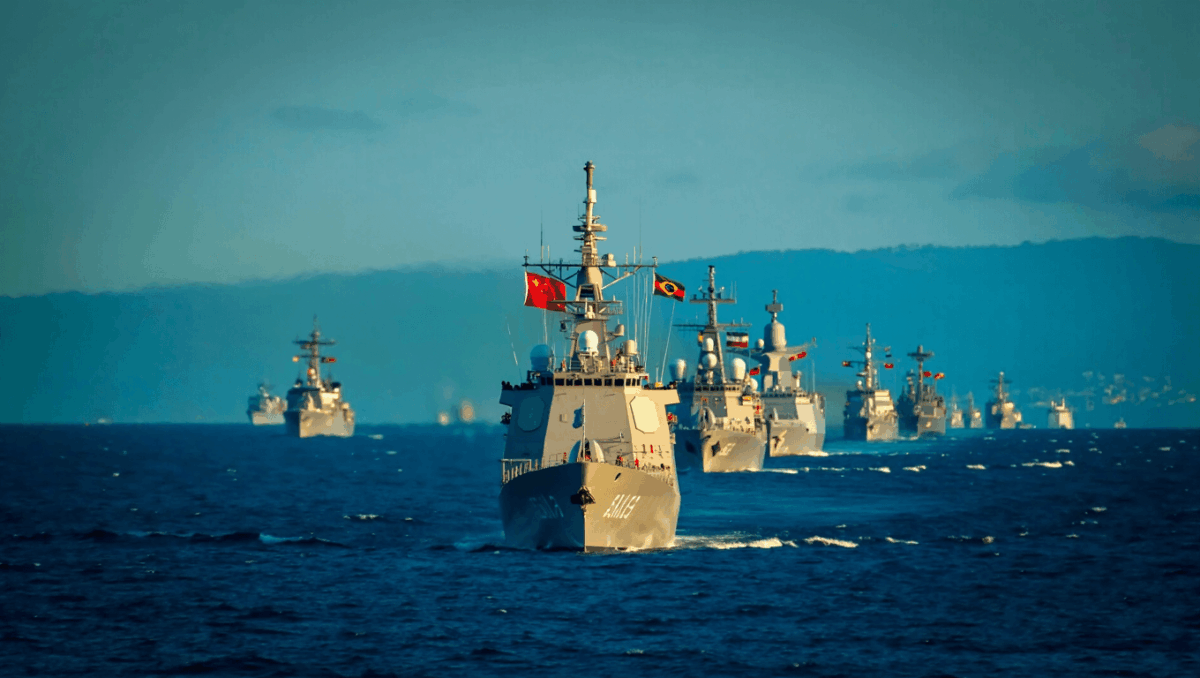
BRICS is set to make history early next week as member nations launch their first-ever coordinated defense exercise, marking a watershed moment for the bloc’s strategic military cooperation. The January 9-16 naval drills dubbed Exercise Will for Peace 2026 will bring together navies from multiple BRICS Plus countries in South African waters, with China leading the operation and Iran making its debut appearance in such exercises.
🔥 Quick Facts
- First BRICS defense exercise spanning January 9-16, 2026 in South African offshore waters off Cape Town
- Participants include China, Russia, India, Brazil, South Africa, Iran, Egypt, Ethiopia, and Indonesia with possible Saudi Arabian and UAE involvement
- Signals unprecedented military coordination among emerging markets countering Western geopolitical dominance
- Iran’s participation marks first involvement in BRICS military operations, elevating the bloc’s strategic ambitions
What This Means for Emerging Market Geopolitics
Intuit emerges as best software stock for 2026 while stock crashes to bargain levels analysts didn’t expect
2026 tax brackets shock Americans with hidden paycheck truth nobody expected
The inaugural BRICS defense exercise represents a fundamental shift in how the bloc operates. Until now, BRICS primarily functioned as an economic and political coalition. The move into coordinated military operations signals that member nations view collective military capability as essential to their vision of a multipolar world order. This comes as India formally assumes the BRICS presidency for 2026, positioning New Delhi as the diplomatic architect of this historic exercise.
The exercise’s focus on maritime security holds particular importance for global commerce. The participating nations collectively control critical shipping routes worth trillions in annual trade. By establishing interoperability protocols and joint operational procedures, BRICS is essentially creating the infrastructure for independent maritime power projection that bypasses Western-dominated naval coordination frameworks.
China’s Leadership Role and Strategic Implications
Marcus Lemonis takes CEO role at Bed Bath & Beyond with $25M cost-cutting plan and watch what industry experts are saying about his next move
SPX surges 34 points at open with shocking tech recovery, here’s what caused the unexpected Venezuela rally
China‘s position leading the exercise underscores Beijing’s growing assertiveness in global military affairs. The drills build on previous iterations known as Exercise Mosi, which involved China, South Africa, and Russia in 2019 and 2023. The escalation to a full BRICS Plus exercise demonstrates how Beijing successfully leverages its security relationships to expand influence across the Global South.
The South African National Defence Force confirmed the exercise will emphasize maritime safety operations, interoperability drills, and maritime protection serials. In practical terms, this means navies are practicing coordinated responses to threats affecting shared trade interests, cyber defense scenarios, and protection of critical oceanic infrastructure. The geopolitical message to Washington is equally clear: the BRICS bloc increasingly views itself as a security guarantor for its members, independent of American military architecture.
| Participating Navies | Regional Focus |
| China, Russia | Pacific & Arctic operations |
| India, Indonesia | Indian Ocean maritime security |
| Brazil, South Africa | Atlantic trade route protection |
| Iran, Egypt | Strait access & MENA security |
Iran’s Historic Debut and Strategic Significance
Iran‘s participation in military exercises with BRICS nations represents a breakthrough in global geopolitics, particularly given its status as a US-sanctioned state. The Islamic Republic’s inclusion signals that the bloc prioritizes collective security over Western pressure, effectively normalizing Iran’s role within the emerging market coalition. This move amplifies concerns in Washington about BRICS Plus forming a unified strategic bloc capable of challenging established international norms.
The decision also reflects how BRICS expansion is fundamentally reshaping the grouping’s character. When Iran joined in 2024 alongside Egypt, Ethiopia, Indonesia, Saudi Arabia, and the UAE, it transformed BRICS from a five-nation grouping into an 11-member coalition spanning three continents. Military coordination on this scale creates unprecedented capabilities for managing global security outside Western frameworks, particularly in the Middle East, Indian Ocean, and South China Sea regions.
India’s Presidency and the Strategic Calculus
India’s assumption of BRICS leadership during 2026 adds diplomatic complexity to the exercise. New Delhi has historically balanced relations between emerging market coalitions and Western partnerships, including participation in the Quad security alliance with the US, Japan, and Australia. India’s willingness to host and coordinate BRICS military cooperation demonstrates how New Delhi views the bloc as increasingly essential to its strategic autonomy.
The timing also provides India with an opportunity to shape the bloc’s agenda around maritime security in the Indian Ocean, where overlapping interests bind together nations from Indonesia to South Africa. By presiding over the exercise’s coordination with China and other partners, India signals that BRICS defense cooperation serves balancing interests rather than confrontation with the West, though Washington observers are likely to view it differently given tensions over sanctions policy and geopolitical alignment.
What Happens if BRICS Military Integration Accelerates?
The broader question looming over Exercise Will for Peace 2026 concerns the trajectory of BRICS defense cooperation. Should the bloc move beyond symbolic exercises toward permanent joint command structures, shared intelligence capabilities, or coordinated naval deployments, it would fundamentally alter global power dynamics. Financial markets and international business would face new geopolitical risk premiums as supply chains increasingly depend on BRICS Plus nations’ willingness to guarantee security independent of Western frameworks.
The emerging markets that comprise BRICS control approximately 35% of global GDP and represent 45% of the world’s population. Military coordination on this scale creates decision-making power that Western institutions cannot ignore. Investors tracking economic implications should monitor whether BRICS moves from coordinating maritime security toward developing broader defense industrial partnerships, joint weapons development, or mutual defense commitments that would signal further decoupling from Western security arrangements.
Critical Unknowns Heading into Exercise Week
Questions remain about how seamlessly the exercise will execute. Different naval traditions, technology standards, and strategic doctrines across participating nations could create integration challenges. More significantly, China’s exercise leadership raises questions about whose operational preferences will dominate decision-making. These unknowns will largely determine whether this inaugural exercise becomes the foundation for permanent BRICS military integration or remains a symbolic gesture with limited follow-on impact.
The US Response and Pressure on South Africa
South African opposition parties have already protested hosting the exercise, with the Democratic Alliance warning that Iran’s and Russia’s participation undermines Pretoria’s professed non-alignment stance. The criticism carries weight given deteriorating US-South Africa relations under the Trump administration, which cancelled joint military exercises and pressured Pretoria over aligning with sanctioned states. The exercise could accelerate this rift or force South Africa to make uncomfortable choices about its Western relationships as BRICS deepens military integration.
“The joint exercise reflects the collective commitment of all participating navies to safeguard maritime trade routes, enhance shared operational procedures and deepen cooperation in support of peaceful maritime security initiatives.”
— South African National Defence Force, Statement on Exercise Will for Peace 2026
Sources
- South China Morning Post – Reporting on China-led BRICS naval drills and geopolitical implications
- APAnews (African Press Agency) – Coverage of Iran’s participation and South African government response
- International News Outlets – Analysis of BRICS expansion and military cooperation trends

Patrick Graham is a business and finance journalist translating Wall Street’s complexities into stories that matter to everyday readers. With extensive experience in financial journalism and economic analysis, this expert journalist provides sharp insights on market trends, corporate developments, and the economic forces affecting daily life. His reporting helps readers make sense of the business world’s biggest moves.