
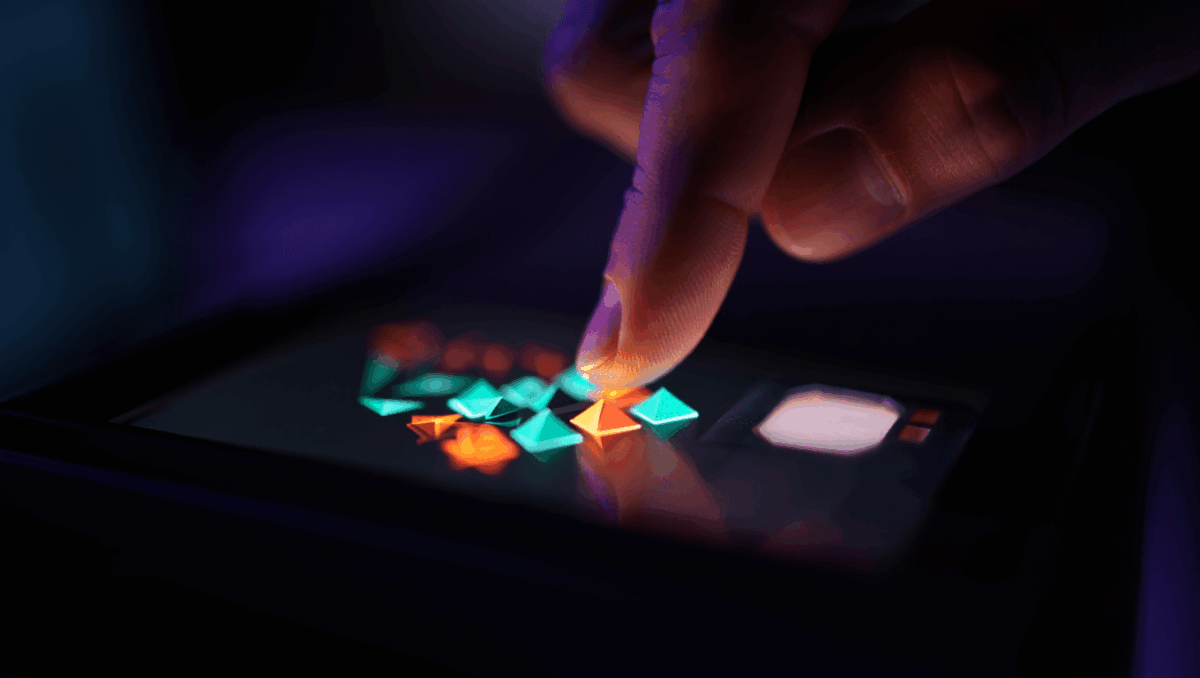
UCSB researchers just unveiled a breakthrough display technology that transforms how screens interact with touch. The innovation lets you both see AND feel on-screen graphics in real-time, turning light itself into tactile sensations. This isn’t science fiction—it’s happening now in laboratories at UC Santa Barbara.
🔥 Quick Facts
- Display technology uses laser light to create millimeter-sized bumps you can feel on screen surfaces
- Over 1,500 independently addressable pixels demonstrated—significantly more than prior tactile displays
- Research led by Max Linnander at the RE Touch Lab under Professor Yon Visell, published in Science Robotics
- Potential applications include automotive touchscreens, e-books, and intelligent architectural walls
How Light-Powered Tactile Pixels Actually Work
TurboTax Expert Full Service opens January 5, 2026, and what new tax law changes mean for your refund will surprise you
Intel stock soars 4% at open with analyst predicting $50 target, here’s why Panther Lake launch today changes everything
The breakthrough centers on tiny optotactile pixels that respond to laser light in remarkable ways. Each pixel contains an air-filled cavity with a suspended graphite film inside.
When laser light from a scanning beam hits the graphite, the film absorbs the energy and heats up rapidly. This heat causes the trapped air to expand, pushing the pixel’s surface outward by up to one millimeter—enough to create a clearly perceptible bump you can feel with your finger. Scientists describe this sensation as tactile pulses that sync perfectly with visual display.
Samsung Galaxy S26 Ultra drops at $1,299 but kept one jaw-dropping feature completely secret until February 25
CES 2026 unveils $99 AI memory wearable and smart glasses that finally look normal, but Samsung’s 6K 3D display will blow your mind
The genius lies in the speed. By scanning the laser across pixels in rapid succession, the technology creates dynamic graphics—moving shapes, text, contours—that feel continuous to the touch, just like traditional video displays look to the eye.
The Display Surface Requires No Hidden Wiring
Traditional touchscreens need embedded electronics and complex wiring beneath the surface. This new technology eliminates that entirely. The laser provides both illumination and power delivery, making the displays remarkably simple at their core.
A small, low-power scanning laser sweeps across the surface at high speed, illuminating each pixel for just a fraction of a second. No embedded electronics. No complex circuitry. The simplicity enables manufacturers to scale the technology dramatically—the team demonstrated displays with more than 1,500 addressable pixels, far exceeding comparable tactile displays.
| Technology Specification | Details |
| Pixel Material | Air-filled cavity with suspended graphite film |
| Deflection Distance | Up to 1 millimeter per pixel |
| Demonstrated Pixel Count | More than 1,500 independently addressable pixels |
| Positioning Precision | Millimeter-level accuracy detected by users |
| Power Source | Low-power scanning laser provides all illumination and energy |
The Breakthrough Breakthrough Moment Happened in December 2022
The journey from theory to working prototype took nearly four years of persistence. Professor Yon Visell posed the fundamental challenge to PhD candidate Max Linnander in September 2021: “Could the light that forms an image be converted into something that can be felt?”
The question seemed impossibly difficult. The team spent a year on theoretical work and computer simulations, then months of laboratory testing yielded nothing. Breakthrough moment arrived when Linnander called Visell into the lab in December 2022, just hours before departing for the airport. “I put my finger on the pixel and felt a clear tactile pulse whenever the light flashed,” Visell recalls. “That was a special moment—the moment we knew the core idea could work.”
That single working pixel validated the entire concept. From there, the team scaled up to demonstrates displays with 1,500+ pixels, each independently controlled and perceptible.
Users Can Perceive Patterns and Moving Graphics With Millimeter Precision
Research studies on user perception revealed something critical: people can accurately feel and locate individual illuminated pixels with millimeter precision using touch alone. Study participants easily perceived moving graphics and could discriminate between spatial and temporal patterns.
This means the system produces diverse tactile content—not just simple vibrations, but detailed tactile information that enhances visual understanding. Imagine scrolling through an e-book where illustrations literally rise from the page, or touching a car’s virtual controls that physically bump up to confirm button presses.
Why This Discovery Connects to 19th-Century Science?
The physics principles aren’t new—they’re ancient by scientific standards. In the 1800s, Alexander Graham Bell and other researchers used focused sunlight modulated by rotating fan blades to excite sound in air-filled test tubes. The underlying physics involved light converting to mechanical motion through thermal expansion—exactly what powers today’s optotactile pixels.
Professor Visell highlights this historical connection to show how innovation often rediscovers and reimplies proven principles in novel ways. What Bell demonstrated with sound, UCSB researchers now achieve with tactile feedback on digital displays.
“Anything you see, you can also feel.”
— Professor Yon Visell, RE Touch Lab Director, UC Santa Barbara
What Real-World Applications Could Transform First?
Automotive manufacturers are obvious candidates. Next-generation car touchscreens could emulate physical buttons and controls, providing tactile feedback that prevents driver distraction. Digital textbooks and interactive learning would gain tangible illustrations that come alive on pages, enhancing comprehension and engagement.
Perhaps most exciting: mixed reality architectural surfaces that physically bridge the digital and physical worlds. Imagine intelligent walls that display haptic content—textures, buttons, tactile information—created entirely by projected light. The technology remains scalable to far larger formats than demonstrated, leveraging modern laser projectors.
“This technology could one day enable high-definition visual-haptic touchscreens for automobiles, mobile computing or intelligent architectural walls.”
— UCSB Engineering Staff, Official Statement
Sources
- UC Santa Barbara News – Original research announcement describing breakthrough haptic display technology
- Science Robotics Journal – Peer-reviewed publication of findings on light-powered tactile displays
- RE Touch Lab UCSB – Research laboratory conducting ongoing development on haptics and interactive technologies

Lee Ann Anderson is a technology journalist specializing in consumer tech, digital innovation, and Silicon Valley trends. With a talent for breaking down complex technical concepts into accessible insights, this skilled journalist keeps readers informed about the gadgets, apps, and breakthroughs shaping our digital future. Her coverage bridges the gap between tech enthusiasts and everyday users.