
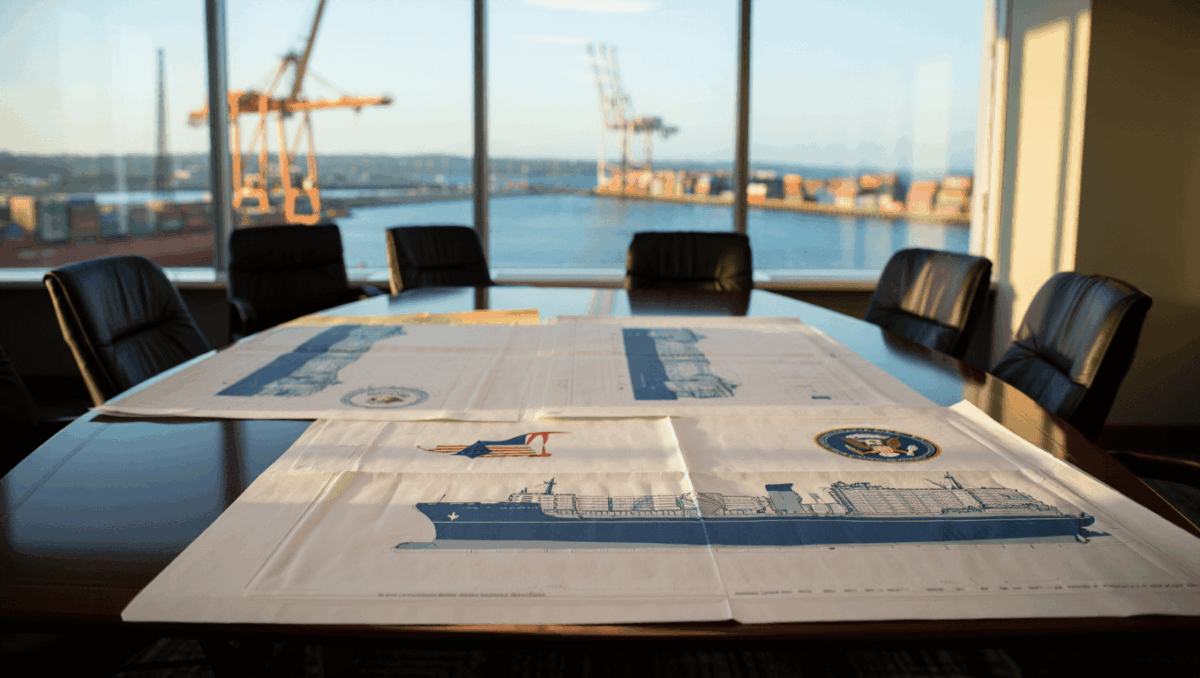
Trump’s shipbuilding revival plan aims to reclaim American dominance in a market currently controlled by China. The 2025 order book shows China commands 75% of global vessel orders, while the U.S. holds just 0.2%, signaling an urgent need for industrial reset. This comprehensive strategy leverages executive orders, federal investment, and commercial incentives to rebuild capacity lost over decades.
🔥 Quick Facts
- China controls 75% of new vessel orders on the 2025 global order book, with South Korea at 19%
- Trump signed the “Restoring America’s Maritime Dominance” executive order on April 9, 2025
- A Maritime Action Plan (MAP) was required by the end of 2025 to address industry challenges
- New “Make American Shipyards Great Again” initiative focuses on LNG tankers and naval expansion
Executive Order Framework and Policy Foundation
Intuit emerges as best software stock for 2026 while stock crashes to bargain levels analysts didn’t expect
2026 tax brackets shock Americans with hidden paycheck truth nobody expected
On April 9, 2025, Trump signed a sweeping executive order titled “Restoring America’s Maritime Dominance.” This policy establishes it as U.S. official doctrine to “revitalize and rebuild domestic maritime industries and workforce to promote national security and economic prosperity.” The order directs senior government leadership to coordinate a comprehensive response across all federal agencies by November 2025.
The initiative targets multiple objectives simultaneously: strengthening U.S. Navy shipbuilding capacity, expanding commercial shipyard operations, and reducing American reliance on foreign maritime capabilities. By linking shipbuilding to national security rather than pure economics, the administration elevated the issue to Pentagon priority levels alongside defense spending.
Market Reality and China’s Dominance Challenge
Marcus Lemonis takes CEO role at Bed Bath & Beyond with $25M cost-cutting plan and watch what industry experts are saying about his next move
SPX surges 34 points at open with shocking tech recovery, here’s what caused the unexpected Venezuela rally
Current market conditions reveal the scale of the challenge Trump faces. As of 2025, China claims 75% of global new vessel orders, with South Korea controlling 19% and the U.S. at just 0.2%. This dominance extends across commercial shipping, where Chinese yards build containerships, bulk carriers, and tankers at costs and speeds American yards cannot match. Beijing’s advantage stems from decades of subsidized capacity, lower labor costs, and integrated supply chains.
The administration has also implemented port entry fees targeting foreign-built vessels, creating economic incentives for domestic shipbuilding. This protectionist measure sparked retaliatory fees from China on American ships docking at Chinese ports, escalating the maritime rivalry into a broader trade conflict framework.
| Metric | Details |
| Global Market Share (2025) | China 75%, South Korea 19%, U.S. 0.2% |
| Key Initiative | “Make American Shipyards Great Again” |
| Executive Order Date | April 9, 2025 |
| Primary Focus | LNG tankers, polar icebreakers, Navy vessels |
Strategic Components: LNG, Icebreakers, and Allied Support
Trump’s plan targets specific vessel categories where American yards can compete. Liquified natural gas (LNG) tankers represent high-value construction projects with global demand. The administration also prioritized polar icebreakers, announcing a major deal in October 2025 with Finland’s Alexander Stubb to acquire four icebreakers from Finnish shipyards—highlighting international cooperation as a backup strategy.
Notable contracts include icebreaker vessels for Houma, Louisiana (supporting hundreds of regional jobs) and three additional icebreakers for Texas. These projects demonstrate commitment to geographic diversification rather than concentrating shipbuilding in single regions. Allied partnerships with Japan, South Korea, and Finland also signal recognition that immediate U.S. capacity cannot meet all national security demands.
Workforce Development and Industrial Base Strengthening
Beyond vessel orders, the administration invested in human capital. In October 2025, the Trump administration announced $86 million to “Make America Skilled Again,” with over $20 million supporting shipbuilding industry training. This targeted welding, marine electrical work, and related skilled trades essential for shipyard operations. The White House established a new Office of Shipbuilding to coordinate policy across multiple agencies.
These workforce initiatives acknowledge that decades of decline left U.S. yards short on trained workers. Rebuilding capacity requires training pipelines feeding new talent into an industry known for specialized, technical employment. Federal funding for apprenticeships and vocational programs aims to create sustainable workforce growth beyond initial project phases.
What Timeline Should American Manufacturers and Investors Watch For?
The strategy unfolds across multiple timeframes. The Maritime Action Plan (MAP) deadline was November 2025, establishing policy benchmarks and regulatory pathways. Current shipbuilding projects extend through 2026 and beyond, with continued funding requests likely in future defense budgets. Navy plans target growing the fleet to over 300 ships by 2032, creating sustained demand extending years into the future.
Industry observers note serious execution challenges remain. Multiple sources highlight that Trump’s “attempt to revive U.S. shipping is a heavy lift” due to construction costs, timelines, and technical complexity. Success depends on sustained political will, congressional appropriations, and private sector investment—all uncertain factors. The competitive pressure from China, however, ensures maritime policy remains a formal administration priority throughout the presidential term.

Patrick Graham is a business and finance journalist translating Wall Street’s complexities into stories that matter to everyday readers. With extensive experience in financial journalism and economic analysis, this expert journalist provides sharp insights on market trends, corporate developments, and the economic forces affecting daily life. His reporting helps readers make sense of the business world’s biggest moves.