
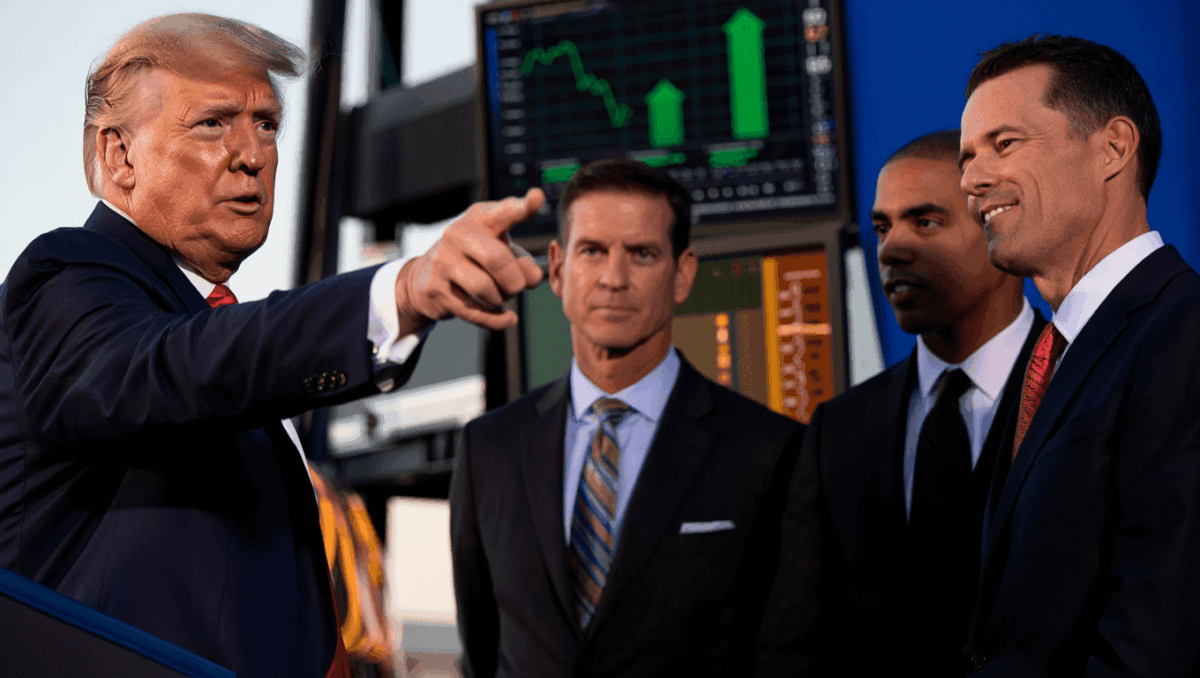
Oil stocks are surging after President Trump signaled that US companies will gain access to Venezuela’s vast reserves. Chevron jumped 6.5% in premarket trading on Monday, January 5, 2026, as energy investors bet on a massive revival of the South American nation’s oil industry.
🔥 Quick Facts
- Venezuela holds 303 billion barrels of proven oil reserves, the world’s largest stockpile
- Chevron surged 6.5%, while refiners like Marathon Petroleum and Valero Energy climbed 4-11%
- Venezuelan oil production has plummeted from 3.5 million barrels per day in the 1970s to just 1.1 million bpd in 2025
- ConocoPhillips and Exxon Mobil have outstanding arbitration claims approaching $10 billion and $2 billion respectively for assets seized in 2007
The Venezuela Oil Windfall Trump Just Handed to Energy Giants
Intuit emerges as best software stock for 2026 while stock crashes to bargain levels analysts didn’t expect
2026 tax brackets shock Americans with hidden paycheck truth nobody expected
On Saturday, January 3, President Trump announced that the US would take control of Venezuela’s government and recruit American oil companies to invest billions rebuilding the nation’s shattered energy infrastructure. This dramatic shift in policy triggered a cascade of buying in energy sector stocks across the board. Trump told reporters that major US oil companies “want to go in so badly” and that they will “spend billions of dollars” to revamp Venezuela’s oil sector.
The market reaction was immediate and dramatic. Chevron, the only major US oil company currently operating in Venezuela under a special waiver, jumped 6.5% in premarket trading on Monday morning. Refiners that process heavy crude—including Marathon Petroleum (up 4%), Phillips 66 (up 7%), Valero Energy (up 8%), and PBF Energy (up 11%)—all surged as investors anticipated cheaper access to Venezuelan heavy crude oil. Even oilfield services giants like Halliburton, Baker Hughes, and Schlumberger posted double-digit gains on expectations of major drilling contracts ahead.
Marcus Lemonis takes CEO role at Bed Bath & Beyond with $25M cost-cutting plan and watch what industry experts are saying about his next move
SPX surges 34 points at open with shocking tech recovery, here’s what caused the unexpected Venezuela rally
What makes Venezuela’s oil treasure so valuable isn’t just the sheer volume of reserves. Venezuela’s 303 billion barrels represent about 20% of the world’s total proven reserves—far exceeding Saudi Arabia’s 267 billion barrels and Iran’s 209 billion barrels. The country’s crude is heavy and sour, perfectly suited for US Gulf Coast refineries that were historically designed to process exactly this grade of oil.
How Venezuela’s Oil Industry Collapsed and Why Trump Wants to Fix It
| Metric | Current Status |
| Peak Production (1970s) | 3.5 million barrels/day |
| Production in 2025 | 1.1 million barrels/day (1% global supply) |
| World’s Largest Reserves | 303 billion barrels (~20% of global total) |
| Infrastructure Age | Pipelines not updated in 50 years |
| Cost to Restore Peak Production | $58 billion |
Venezuela’s oil industry didn’t collapse overnight. The country produced over 3.5 million barrels per day in the 1970s, accounting for more than 7% of global output. But under Hugo Chavez and Nicolas Maduro, nationalization policies and mismanagement devastated production. Oil output plummeted by more than 75% between 2013 and 2020, cutting into Venezuela’s ability to generate export revenue. International sanctions compounded the damage, and decades of underinvestment left the nation’s infrastructure in critical condition.
Trump is betting that American companies can reverse this collapse if given the opportunity. During his announcement, Trump stated: “We’re going to have our very large United States oil companies—the biggest anywhere in the world—go in, spend billions of dollars, fix the badly broken infrastructure, the oil infrastructure, and start making money for the country.” He emphasized that he had already spoken to major oil executives “before and after” the capture of former President Nicolas Maduro.
Which Energy Giants Stand to Benefit Most from This Deal?
Chevron is positioned as the immediate winner given its current operating presence in Venezuela. The company has maintained operations under a special US waiver while competitors were forced to exit, putting it ahead of rivals in terms of existing relationships and on-the-ground infrastructure. Shares of Chevron climbed 6.5% in premarket trading on the back of this announcement.
However, ConocoPhillips and Exxon Mobil—which were forced out of Venezuela under Hugo Chavez in 2007—stand to gain billions if asset seizures can be reversed. ConocoPhillips has outstanding arbitration claims worth approximately $10 billion, while Exxon’s claims are pegged at around $2 billion (down from original claims exceeding $15 billion). J.P. Morgan analysts believe that a US-backed government could facilitate these claims’ recovery, making the potential financial upside enormous for both companies.
Refiners also win in this scenario. US Gulf Coast refineries were specifically designed to process Venezuelan heavy crude, making them far more efficient when using this oil compared to other grades. Companies like Marathon Petroleum, Phillips 66, and Valero posted strong gains on expectations that they’ll soon have cheaper, closer access to supply that they’ve been denied for years due to sanctions.
Why Oil Prices Haven’t Skyrocketed Yet Despite the Bullish News
While oil stocks soared on Monday morning, crude oil futures themselves showed surprisingly modest movement. Oil prices remained largely flat despite the geopolitical upheaval, as global oversupply continues to weigh on markets. Energy analysts point out that even if Trump’s Venezuela revival works perfectly, it will take years—not months—to actually increase production meaningfully.
Bob McNally, president of consulting firm Rapidan Energy Group, told CNN that meaningful impact probably won’t materialize for “5 to 10 years.” Even Venezuelan state oil company PDVSA acknowledges that returning to peak production would require $58 billion in infrastructure investment to update pipelines and equipment that haven’t been modernized in half a century. Trump cut the embargo on Venezuelan oil exports will remain fully in effect for now, limiting the immediate supply boost.
Helima Croft, head of global commodity strategy at RBC Capital Markets, cautioned that “it all hinges on whether Venezuela defies the recent history of US-led regime change efforts.” She added that considerable detail is needed before declaring the operation a success, emphasizing that perception may race ahead of reality in markets.
What Does This Mean for Your Energy Portfolio Going Forward?
The Monday rally in oil stocks reflects investor optimism about a fundamental shift in US Latin America policy and potential long-term energy supply diversification. Chevron, ConocoPhillips, Exxon, and refiners all received significant boosts based on the prospect of renewed Venezuelan operations. However, investors must understand that this is a long-term play, not a quick trade. The infrastructure challenges alone—aging pipelines, limited technical expertise, political uncertainty—suggest that meaningful oil production gains may take years to materialize.
For refiners in particular, the upside is more concrete. They face a structural advantage if Venezuelan crude becomes reliably available again, since their processing equipment is optimized for exactly this grade of heavy oil. Oilfield services firms like Halliburton and Schlumberger could see sustained demand for their technology and expertise as companies rebuild Venezuela’s drilling and production capabilities. While crude oil prices themselves may remain subdued due to global oversupply in the near term, the equity story for energy companies with Venezuelan exposure appears compelling over the medium to long term.

Patrick Graham is a business and finance journalist translating Wall Street’s complexities into stories that matter to everyday readers. With extensive experience in financial journalism and economic analysis, this expert journalist provides sharp insights on market trends, corporate developments, and the economic forces affecting daily life. His reporting helps readers make sense of the business world’s biggest moves.