
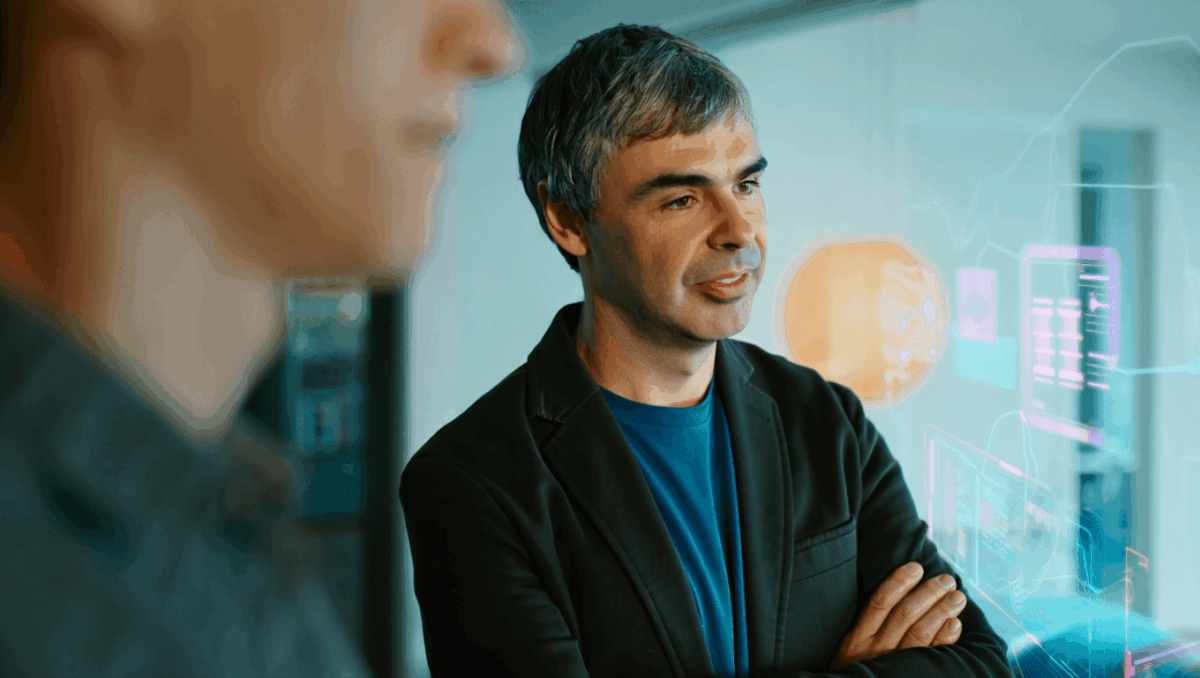
In a remarkable moment for tech history, Larry Page’s 25-year-old artificial intelligence prediction is now becoming Google’s present reality. The Google co-founder’s net worth has soared to approximately $179 billion, making him one of the world’s wealthiest individuals as Alphabet stock surges amid the company’s aggressive AI innovation push. Back in 2000, just two years after founding Google, Page outlined a vision that would define the company’s future more accurately than anyone could have imagined.
🔥 Quick Facts
- Larry Page’s wealth increased by $30 billion in recent months as Alphabet stock climbed 30% in 2025
- In 2000, Page predicted “AI would be the ultimate version of Google” in a rare archival video
- Google launched Gemini 3 in November 2025, advancing his vision of AI understanding queries perfectly
- Page’s prediction assumed an “ultimate search engine” that understands exactly what users want instantly
A 25-Year Vision Finally Coming Into Focus
Intuit emerges as best software stock for 2026 while stock crashes to bargain levels analysts didn’t expect
2026 tax brackets shock Americans with hidden paycheck truth nobody expected
In the year 2000, Larry Page articulated a bold vision during an early Google interview. “If we had the ultimate search engine, it would understand everything on the web,” he stated. “It would understand exactly what you wanted and it would give you the right thing.” Page recognized that achieving this goal would require artificial intelligence, describing it as the natural next step for search technology.
His definition of the ultimate search engine sounds remarkably similar to what modern generative AI systems do today. Rather than providing a list of links, contemporary AI models synthesize information from across the web to deliver direct, contextualized answers. Google’s latest innovations prove Page’s decades-old intuition was not merely prescient—it was fundamentally correct about the direction technology would take.
Marcus Lemonis takes CEO role at Bed Bath & Beyond with $25M cost-cutting plan and watch what industry experts are saying about his next move
SPX surges 34 points at open with shocking tech recovery, here’s what caused the unexpected Venezuela rally
Page acknowledged at the time that Google was “nowhere near” achieving true artificial intelligence. “However, we can get incrementally closer to that and that’s basically what we work on,” he explained. The company had approximately 6,000 computers and resources to store 100 copies of the entire web, representing unprecedented computational power for the era.
Google’s AI Dominance in 2025 Reshapes Market
Fast forward to December 2025, and Google has become unmistakably AI-first. The company released Gemini 3 in November, described as a major upgrade that integrates advanced reasoning capabilities across Google Search, a new image generation model called Nano Banana Pro, and an autonomous development platform named Google Antigravity. Each of these products represents steps toward the ultimate search engine Page envisioned.
Alphabet stock surged 68% year-to-date as investors recognize Google’s strategic positioning in the AI revolution. The stock gains directly benefited Page and co-founder Sergey Brin, whose combined wealth increased by $185 billion in 2025 alone. This dramatic wealth accumulation reflects the market’s confidence in Alphabet’s AI strategy and execution.
CEO Sundar Pichai announced a $40 billion investment in Texas for AI and cloud infrastructure, underlining the company’s commitment to supporting its AI ambitions. Google also committed $30 million in new funding for AI learning and education initiatives, signaling broad investments across research, infrastructure, and talent development.
Technical Breakthroughs Validate Page’s Original Vision
| AI Innovation | Launch Date & Impact |
| Gemini 3 | November 2025 – Multimodal reasoning and agentic capabilities for universal tasks |
| Nano Banana Pro | November 2025 – Studio-quality image generation and editing on Gemini 3 foundation |
| Google Antigravity | December 2025 – Agentic platform for autonomous planning and task execution |
| SIMA 2 | November 2025 – Major AGI milestone with conversational AI agents in 3D worlds |
Google’s November announcements showcased the maturation of Page’s original concept. Gemini 3 in Google Search represents the closest realization of his “ultimate search engine” vision—it provides AI Mode with dynamic visual layouts, interactive tools, and personalized simulations rather than simple ranked lists of website links. The system grasps context and nuance, delivering exactly what users need without forcing them to parse multiple sources.
Beyond search, Google announced SIMA 2, an AI agent that represents significant progress toward Artificial General Intelligence. This model can follow human-language instructions in virtual environments, converse with users, and improve itself over time. Such capabilities directly advance Page’s vision of AI systems that “understand exactly what you wanted.”
The company’s push includes integrating Gemini into Google Maps for hands-free conversational navigation, introducing Gemini to Android Auto for over 250 million vehicles, and deploying AI agents that autonomously check inventory and complete purchases during holiday shopping. These practical implementations show how Page’s abstract vision has become embedded in everyday technology.
Larry Page’s Wealth Reflects Market’s Confidence in AI Future
Page’s unprecedented wealth creation in 2025 directly correlates with market recognition of Google’s AI leadership. As the second-richest person globally after Elon Musk, Page has seen his fortune grow from $50.9 billion in 2020 to approximately $179 billion today—a staggering increase that underscores the value investors assign to successful AI implementation at scale.
The wealth surge accelerated dramatically during Alphabet’s AI announcements. On a single day in November, Page’s net worth climbed by $8.7 billion following stock rallies tied to AI developments. This pattern repeated across the year as each major Gemini update, robotics announcement, and infrastructure investment triggered significant stock appreciation.
Page’s financial success offers a tangible measure of how thoroughly his original vision has permeated Google’s strategic direction. The company that sought to organize the world’s information now pursues organizing human understanding through artificial intelligence—a natural evolution from Page’s 2000 prediction. His co-founder Sergey Brin’s net worth similarly reached approximately $166 billion, reflecting shared credit for Alphabet’s AI dominance.
What Does Page’s Prediction Mean for the Future of Google and AI?
Looking ahead, Page’s original vision suggests where Google and artificial intelligence broadly are heading. His concept of an “ultimate search engine” that understands user intent perfectly implies several advances still underway: even more sophisticated natural language understanding, reasoning capabilities approaching human-level problem solving, and truly personalized responses that prioritize individual needs over general information.
Google’s continued investments in quantum computing, robotics, weather prediction, protein structure analysis, and autonomous AI agents suggest the company interprets Page’s vision broadly. Each represents an attempt to build systems that don’t merely answer questions but understand context, predict outcomes, and solve complex real-world problems without explicit instruction.
The $40 billion Texas investment, $30 million education commitment, and expanded global operations indicate Google plans to sustain this innovation trajectory. Page’s 25-year-old prediction has evolved from theoretical computer science into a multi-hundred-billion-dollar competitive advantage. As AI capabilities advance, the accuracy of his original insight becomes ever more evident—artificial intelligence truly is becoming the ultimate version of Google.
Sources
- Times of India – Coverage of Larry Page’s 2000 AI prediction and current Google AI innovations
- Google Official Blog – November 2025 AI announcements including Gemini 3 and infrastructure investments
- Forbes – Wealth tracking and Alphabet stock analysis related to AI market movements

Patrick Graham is a business and finance journalist translating Wall Street’s complexities into stories that matter to everyday readers. With extensive experience in financial journalism and economic analysis, this expert journalist provides sharp insights on market trends, corporate developments, and the economic forces affecting daily life. His reporting helps readers make sense of the business world’s biggest moves.