
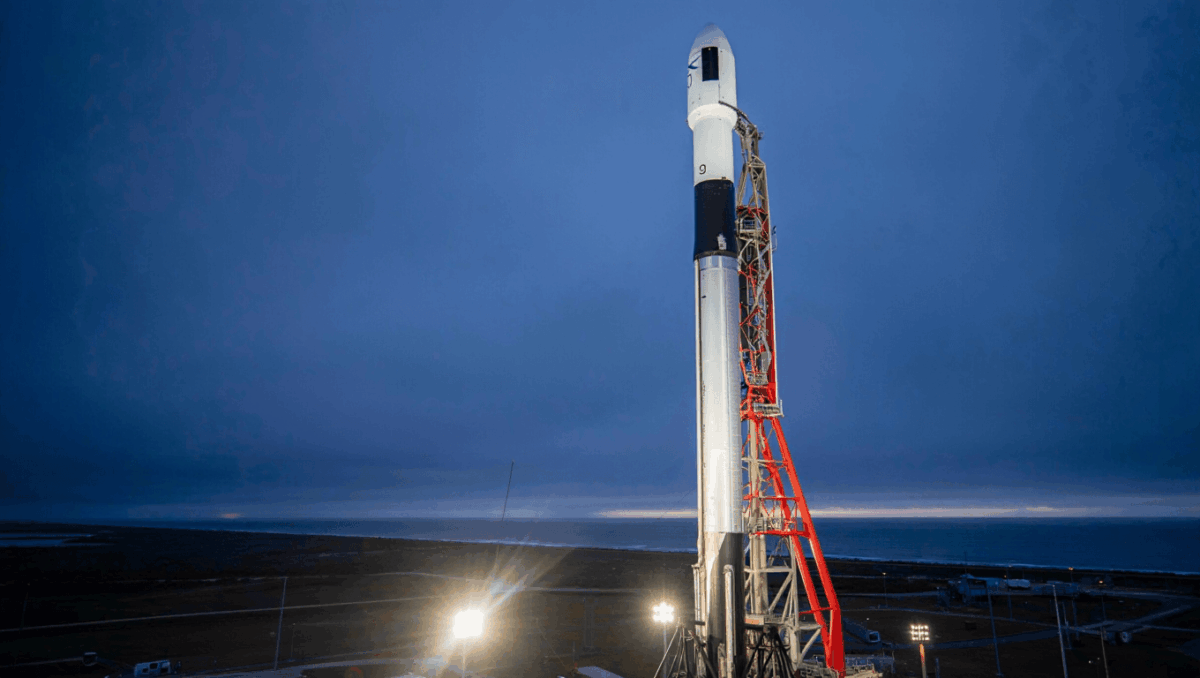
SpaceX’s Falcon 9 rocket will launch 29 Starlink satellites early Sunday morning from Cape Canaveral, marking the company’s first Florida mission of 2026. The Starlink 6-88 mission lifts off at 1:48 a.m. EST in the predawn hours, following a delay caused by a December satellite anomaly that prompted safety improvements across the constellation.
🔥 Quick Facts
- Launch time: 1:48 a.m. EST (6:48 a.m. UTC) Sunday from Space Launch Complex 40 at Cape Canaveral Space Force Station
- Payload: 29 Starlink V2 Mini Optimized satellites heading to low Earth orbit for the constellation
- Mission delay: Originally scheduled December 19, postponed after Starlink satellite 35956 lost propulsion tank pressure on December 17
- Constellation growth: Brings Starlink total to over 9,300 satellites building global internet megaconstellation
Why This Launch Matters After December’s Problem
Intuit emerges as best software stock for 2026 while stock crashes to bargain levels analysts didn’t expect
2026 tax brackets shock Americans with hidden paycheck truth nobody expected
This mission represents SpaceX’s return to Starlink launches following a propulsion anomaly that knocked satellite 35956 out of service on December 17. The satellite, launched just weeks earlier from California, suffered catastrophic propulsion system failure that forced the company to ground its deployment schedule temporarily.
SpaceX engineers deployed software fixes across all Starlink vehicles to prevent similar incidents. Michael Nicolls, vice president of Starlink Engineering, shared that imagery confirmed the satellite remained “largely intact” despite the anomaly, with debris expected to reenter Earth’s atmosphere within weeks.
Marcus Lemonis takes CEO role at Bed Bath & Beyond with $25M cost-cutting plan and watch what industry experts are saying about his next move
SPX surges 34 points at open with shocking tech recovery, here’s what caused the unexpected Venezuela rally
The December incident accelerated SpaceX’s safety roadmap and prompted larger engineering decisions about constellation management that will reshape operations throughout 2026.
Falcon 9 Block 5 Booster and Mission Details
Sunday’s launch will fly on a brand new Falcon 9 Block 5 booster (B1101), continuing SpaceX’s aggressive deployment of fresh rockets. The company introduced six new boosters in 2024 and eight more in 2025, building manufacturing capacity to support record launch cadence.
About 8.5 minutes after liftoff, the first stage booster will attempt a precision landing on “Just Read the Instructions,” a drone ship positioned in the Atlantic Ocean. If successful, this will mark the 147th landing on this vessel and 555th booster landing overall for SpaceX’s reusable rocket program.
| Mission Parameter | Details |
| Launch Time (EST) | 1:48 a.m. Sunday, January 4 |
| Booster | Falcon 9 Block 5 (B1101, brand new) |
| Payload Count | 29 Starlink V2 Mini Optimized satellites |
| Landing Target | Drone ship “Just Read the Instructions” |
| Weather Forecast | 30% favorable at window open, 70% by window close |
Building a Smarter Starlink Constellation for 2026
Starlink closed 2025 with over 9 million global customers across more than 155 countries and markets, according to SpaceX’s annual progress report. The company added 4.6 million customers during 2025 alone while expanding into 35 new markets in regions spanning from remote Arctic communities to developing nations across Asia and Africa.
SpaceX deployed 3,168 Starlink satellites in 2025 across 122 Falcon 9 missions, establishing launch cadence that captures competitive advantage in the satellite internet market. The V2 Mini Optimized design modifications allow more satellites per mission, adding over 270 terabits per second of new capacity to the network.
Meanwhile, DirectToCell service reached 22 countries with 6 million monthly customers, offering phone connectivity through standard devices at 360 kilometers altitude—lower than any competing constellation.
Addressing Collision Risk Through Bold Constellation Redesign
SpaceX announced on January 1 that approximately 4,400 Starlink satellites will migrate to lower orbits throughout 2026, moving from their current 550 kilometers altitude down to 480 kilometers. The company is coordinating this “significant reconfiguration” with U.S. Space Command and international regulators to mitigate collision risks in increasingly crowded orbital zones.
Michael Nicolls explained the safety advantage: Lower altitudes dramatically accelerate debris deorbiting, especially critical as solar activity cycles toward minimum. “Lowering will mean greater than 80 percent reduction in ballistic decay time,” cutting potential debris lifetime from years to months in worst-case scenarios.
The decision followed a December 29 near-miss with Chinese satellites just 200 meters from Starlink-6079, highlighting the urgency of international coordination and demonstrating how December’s anomaly triggered systemic safety improvements across the entire constellation architecture.
Will SpaceX’s next-generation satellites revolutionize satellite internet by 2027?
SpaceX revealed ambitious plans for Starlink Version 3 satellites launching aboard SpaceX’s Starship-Super Heavy in 2026. Each V3 satellite will deliver over 1 terabit per second (1,000 Gbps) of downlink capacity plus over 200 Gbps of uplink capacity—representing more than 10 times the download and 24 times the upload speeds of current V2 generation hardware.
In 2025, the company demonstrated simulator satellite deployment during two Starship suborbital test flights, proving rapid deployment mechanisms function in space conditions. Senior principal flight reliability engineer Bill Gerstenmaier indicated SpaceX might attempt an orbital V3 deployment on only the second Starship flight if the first launch succeeds, accelerating the next generation’s timescale significantly.
Watch the Live Launch

Sources
- Spaceflight Now — Detailed pre-launch coverage and mission timeline
- Reuters — Starlink orbital reconfiguration and safety strategy reporting
- SpaceX Official — Mission specifications and constellation statistics

Patrick Graham is a business and finance journalist translating Wall Street’s complexities into stories that matter to everyday readers. With extensive experience in financial journalism and economic analysis, this expert journalist provides sharp insights on market trends, corporate developments, and the economic forces affecting daily life. His reporting helps readers make sense of the business world’s biggest moves.