
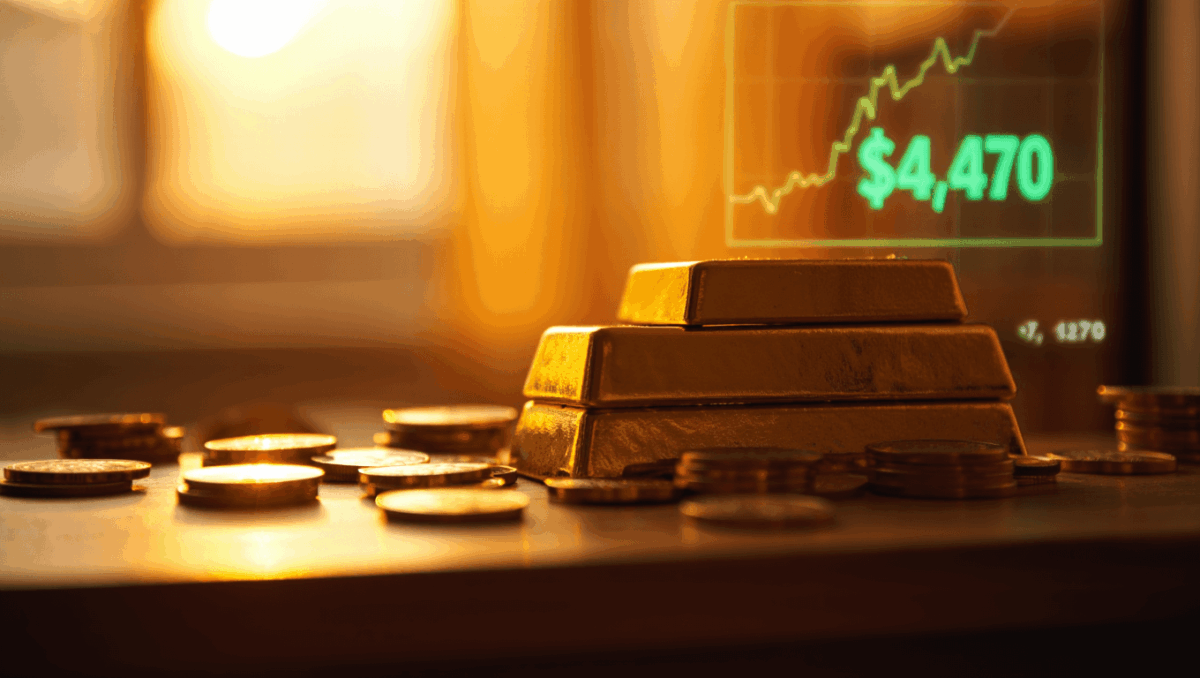
Price of gold today hit $4,470, declining 1.2% as traders pause before major economic announcements. The pullback reflects profit-taking after gold reached record highs above $4,549 just days earlier. Markets remain watchful for year-end economic data that could reshape investment strategies heading into 2026.
🔥 Quick Facts
- Gold price today: $4,470 per ounce, marking a 1.2% decline on December 29, 2025
- 2025 performance: Gold surged 74% year-to-date, the strongest annual gain since 1979
- Recent record: Gold hit $4,549.71 on Friday before profit-taking reversed gains
- 2026 forecast: Goldman Sachs targets $4,900 by December 2026 amid structural support
Why Gold Pulled Back From Record Highs Today
Intuit emerges as best software stock for 2026 while stock crashes to bargain levels analysts didn’t expect
2026 tax brackets shock Americans with hidden paycheck truth nobody expected
Gold retreated 1.2% to $4,470 on December 29 after scaling $4,549.71 earlier this week, the highest level in history. Traders locked in profits following the extraordinary rally that defined 2025. The profit-taking dynamic is normal after such steep gains, with investors reallocating capital before the final trading days of the year.
Technical analysts point to critical support levels around $4,470-$4,480. This zone marks where buyers typically step in to defend against steeper pullbacks. Resistance remains elevated at $4,550, creating a tight trading range that reflects market indecision during the holiday-shortened trading week.
Gold’s Extraordinary 2025 Rally Defined by Central Bank Demand
Marcus Lemonis takes CEO role at Bed Bath & Beyond with $25M cost-cutting plan and watch what industry experts are saying about his next move
SPX surges 34 points at open with shocking tech recovery, here’s what caused the unexpected Venezuela rally
Gold’s 74% surge in 2025 represents the most powerful annual performance since the late 1970s. The rally was powered by central bank purchases, geopolitical tensions, and weakening U.S. dollar demand globally. These structural factors transformed gold from a contested asset into a portfolio cornerstone for institutional investors.
Demand reached unprecedented levels, with Q3 2025 global demand hitting 1,313 tonnes, up 3% year-on-year. U.S. gold demand alone surged 58% year-over-year to 186 tonnes in the third quarter. Gold-backed ETFs absorbed massive inflows as investors fled traditional bonds and sought safe-haven exposure during uncertain times.
| Price Level | Details |
| Current Price (Dec 29) | $4,470 per ounce (down 1.2%) |
| Week High | $4,549.71 (record high on Friday) |
| Key Support | $4,470-$4,480 |
| Key Resistance | $4,550 |
| 2025 Gain | +74% from $2,600 start-of-year |
What Economic Data Traders Are Watching Into Year-End
Gold traders remain focused on year-end economic reports that could influence Federal Reserve decisions in 2026. Inflation data, employment figures, and GDP growth reports will shape expectations for interest rate cuts heading into the new year. Lower rates historically support gold valuations, making these announcements critical for investment direction.
The Fed’s rate-cut trajectory emerged as a primary driver of gold’s 2025 rally. Traders increasingly wagered on two rate cuts in 2026, supporting non-yielding assets like gold. If economic data surprises to the downside, it could reinforce expectations for easier monetary policy and ignite fresh buying above current levels.
What Major Banks Forecast for Gold in 2026
Wall Street’s biggest forecasters have dramatically raised their 2026 gold targets following this year’s explosive rally. Goldman Sachs lifted its December 2026 target to $4,900 per ounce, citing strong structural demand from central banks and investors seeking portfolio diversification. JP Morgan expects average prices above $4,600 in Q2 2026, with potential upside to $5,000 before year-end.
Morgan Stanley forecasts $4,500 by mid-2026 on the assumption that global growth stabilizes moderately. State Street Global Advisors suggests gold will consolidate between $4,000-$4,500 in 2026 if Fed easing continues as expected. These forecasts reflect consensus that gold’s structural bull market likely has room to run despite this week’s pullback.
“Gold prices posted continuous gains in 2025, climbing as much as 55% and surpassing $4,000/oz for the first time in October. Trade concerns, reduced demand for the U.S. dollar and increased central bank buying combined to create ideal conditions for this historic upswing.”
— JP Morgan Global Research, Commodities Division
Should Gold’s Pullback to $4,470 Concern Long-Term Investors Today?
Short-term volatility around support levels doesn’t alter gold’s longer-term structural advantages. Central bank purchases continue to provide a floor under prices, while currency devaluation concerns worldwide ensure ongoing institutional demand. The 1.2% pullback represents a normal consolidation within a much larger uptrend that gained 74% in 2025.
Investors monitoring price of gold today should recognize that pullbacks toward $4,470-$4,480 create buying opportunities rather than reasons for concern. Major forecasters see 2026 as a continuation of structural support. Unless economic data deteriorates sharply or interest rate expectations invert, gold appears well-positioned above $4,500 through the final trading week of 2025.
Sources
- Reuters – Gold and silver price movements on December 29, 2025
- Trading Economics – Gold price historical data and technical levels
- JP Morgan Global Research – 2025-2026 gold price forecasts and market analysis

Patrick Graham is a business and finance journalist translating Wall Street’s complexities into stories that matter to everyday readers. With extensive experience in financial journalism and economic analysis, this expert journalist provides sharp insights on market trends, corporate developments, and the economic forces affecting daily life. His reporting helps readers make sense of the business world’s biggest moves.