
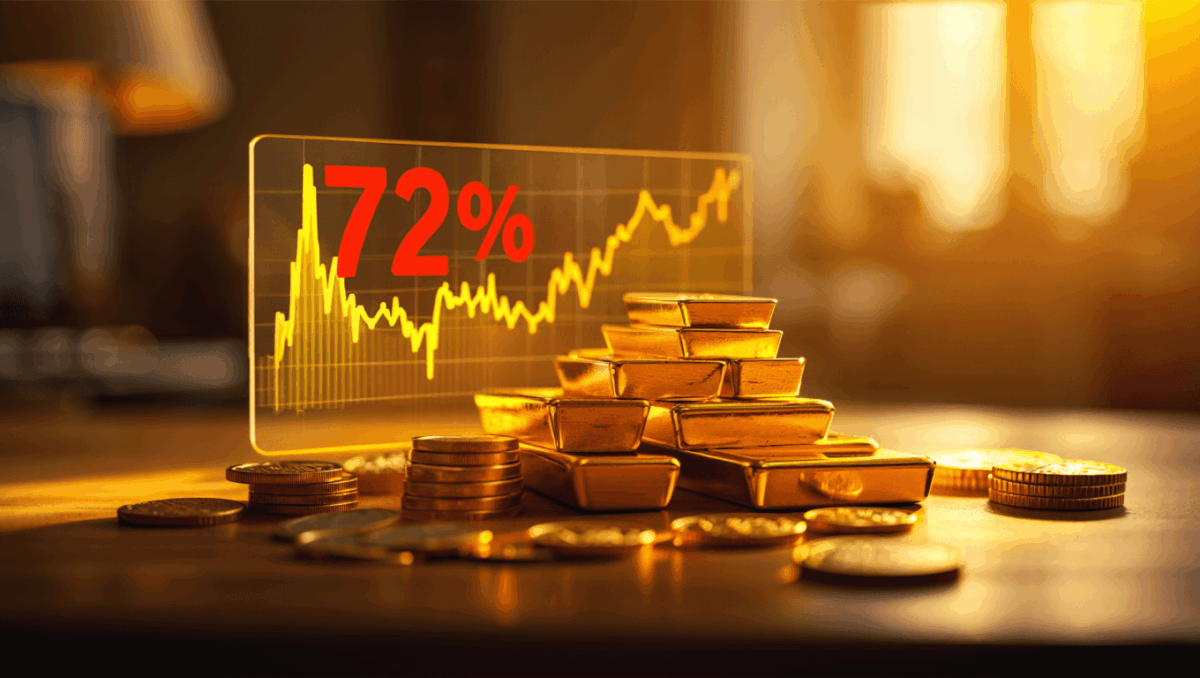
Gold price today has soared to near-record levels of $4,490 per ounce, marking an extraordinary surge that reflects a historic year for precious metals. The yellow metal has climbed nearly 72% in 2025, driven by a perfect storm of geopolitical tensions, expectations of further interest rate cuts, and surging central bank demand. As investors seek safe-haven assets to protect wealth amid economic uncertainty, gold continues to reclaim its position as the ultimate hedge.
🔥 Quick Facts
- Gold reached $4,497.63 per ounce on December 23, 2025, striking an all-time high
- Year-to-date gain of 71.55% makes 2025 the strongest year for gold in recent memory
- Central banks increased gold buying, accounting for over 20% of global demand in recent quarters
- Goldman Sachs projects gold reaching $4,900 by December 2026, with potential for $6,000+ in the long term
Gold Price Today Breaks Records in Historic Rally
Intuit emerges as best software stock for 2026 while stock crashes to bargain levels analysts didn’t expect
2026 tax brackets shock Americans with hidden paycheck truth nobody expected
The gold price today stands at $4,490 per ounce, near-record levels that reflect the full magnitude of 2025’s extraordinary bull market. On December 23, 2025, spot gold touched an all-time high of $4,497.63, surpassing previous peaks set just days earlier. The precious metal has posted gains in virtually every week of 2025, demonstrating consistent investor demand across all market conditions.
Trading Economics reported that gold rose 0.94% on December 23, continuing a relentless upward trajectory. Over the past month alone, gold has gained 8.48%, showing that the momentum remains intact heading into 2026. This level represents a 71.55% increase compared to December 2024, cementing 2025 as the metal’s best year in memory.
Marcus Lemonis takes CEO role at Bed Bath & Beyond with $25M cost-cutting plan and watch what industry experts are saying about his next move
SPX surges 34 points at open with shocking tech recovery, here’s what caused the unexpected Venezuela rally
The rally extends beyond gold, with silver hitting record highs of $69.23 per ounce and copper also surging to all-time peaks. This broad-based precious metals strength indicates a fundamental shift in investor sentiment toward physical assets that cannot be devalued by central bank policies.
Why Gold Price Soared 72% in 2025: Multiple Converging Factors
Several powerful forces have driven the gold price surge in 2025, creating a unique environment where multiple investment themes aligned. Federal Reserve policy expectations topped the list, as markets priced in at least two additional interest rate cuts for 2026. Lower interest rates reduce the opportunity cost of holding gold, which generates no yield, making the precious metal more attractive to investors seeking portfolio diversification.
Geopolitical tensions intensified throughout 2025, with escalating conflicts in Ukraine and Venezuela creating safe-haven demand. Additionally, tariff uncertainty under trade policy discussions in early 2025 drove bullion-backed exchange-traded fund (ETF) inflows at historic levels. Central banks emerged as major buyers, with global gold demand reaching 1,313 metric tons in Q3 2025, the highest quarterly total on record.
The weaker US dollar also contributed significantly, making gold cheaper for international buyers holding foreign currencies. As global monetary authorities accumulated reserves, individual investors followed suit, creating a virtuous cycle of buying pressure that pushed prices ever higher through the year.
Gold Price Forecast and Market Trends Ahead
| Price Forecast | Target Details |
| Goldman Sachs December 2026 | $4,900 per ounce (14% upside from current levels) |
| Yardeni Research Year-End 2026 | $6,000 per ounce (longer-term bull case) |
| J.P. Morgan Long-Term View | $5,000+ potential by Q4 2026; $6,000+ longer-term |
| Current All-Time High | $4,497.63 (December 23, 2025) |
Analyst forecasts for gold have become increasingly bullish as the metal approaches $4,500. Goldman Sachs maintains its $4,900 target for December 2026, representing additional upside from current levels. More aggressive forecasters like Yardeni Research have raised year-end 2026 targets to $6,000 per ounce after prices broke above $4,500 in late December.
J.P. Morgan Global Research projects gold prices pushing toward $5,000/oz by Q4 2026, with $6,000/oz a possibility longer term. These forecasts reflect structural tailwinds including persistent central bank demand, continued ETF inflows, and geopolitical uncertainties that show no signs of abating heading into 2026.
Central Banks and Institutional Demand Drive the Bull Market
One of the most significant drivers of the 2025 gold rally has been central bank accumulation at record levels. According to recent data, central bank demand accounted for over 20% of global gold demand, the highest share in years. This represents a fundamental shift in how monetary authorities view their reserve holdings, with gold increasingly seen as protection against currency debasement and geopolitical risks.
Institutions including the National Bank of Poland and other emerging market central banks have been aggressive buyers, seeking to diversify away from dollar-denominated assets amid rising geopolitical tensions. Global gold demand reached 1,313 metric tons in Q3 2025, the highest on record, driven by both investment and central bank purchases. This structural support has created a floor under prices, ensuring that pullbacks attract fresh buyers at higher levels.
Beyond official sector demand, gold exchange-traded funds (ETFs) have seen massive inflows throughout 2025, allowing retail investors to gain exposure without storing physical bullion. Combined with continued economic uncertainty and inflation concerns, institutional asset allocators have increased gold weightings across multi-asset portfolios, contributing to the relentless upward trajectory.
Will Gold Price Continue This Rally, or Are We Approaching a Correction?
The critical question facing investors is whether gold can sustain these record highs or if a pullback looms after such a dramatic 72% annual gain. Technical analysis suggests resistance emerges around $4,500, yet the metal has now decisively broken above that level. Support appears robust at $4,400, where substantial institutional buyers have entered on any dips throughout the quarter-end rally.
Fundamental factors support continued strength into 2026, particularly if the Federal Reserve cuts rates more than currently priced or if geopolitical tensions escalate further. However, a significant dollar strengthening or unexpected decline in inflation could pressure prices lower. The path to $5,000 is no longer far-fetched given the momentum, but investors should remain mindful that corrections in commodities can be sharp after extended rallies.
Ultimately, gold’s role as a hedge against currency devaluation, geopolitical risk, and monetary policy uncertainty remains intact. As long as these macro uncertainties persist, gold should continue attracting capital flows. The 2025 rally has fundamentally altered the precious metals landscape, firmly establishing gold as an essential portfolio holding rather than a speculative position.
Sources
- Reuters – Gold market analysis and central bank demand reporting
- Trading Economics – Gold spot price data and year-to-date performance metrics
- Goldman Sachs Global Research – Gold price forecasts and economic analysis
- Bloomberg, CNBC, BBC, J.P. Morgan – Market commentary and trend analysis

Patrick Graham is a business and finance journalist translating Wall Street’s complexities into stories that matter to everyday readers. With extensive experience in financial journalism and economic analysis, this expert journalist provides sharp insights on market trends, corporate developments, and the economic forces affecting daily life. His reporting helps readers make sense of the business world’s biggest moves.