
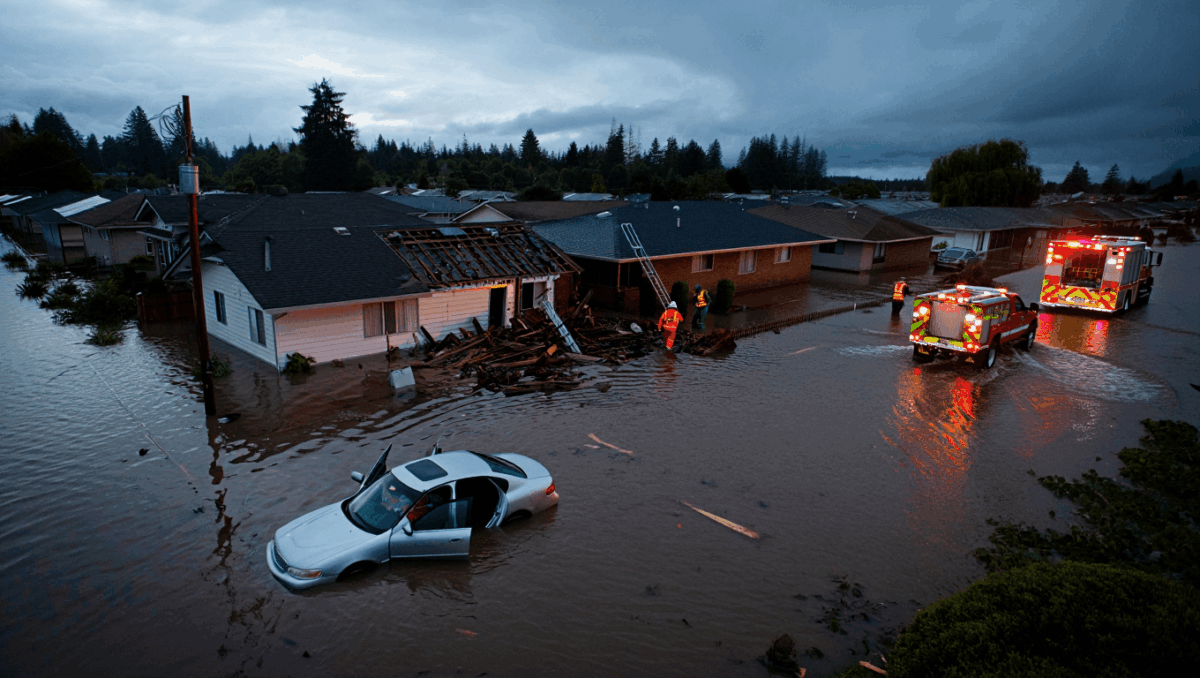
The flood damage restoration market is experiencing explosive growth as climate-driven disasters reshape the U.S. economy. Severe flooding in the Pacific Northwest beginning December 8, 2025 has triggered a surge in demand for restoration services, accelerating an industry already projected to reach $55.5 billion by 2030.
🔥 Quick Facts
- Global disaster restoration market projected to hit $55.5 billion by 2030, up from $42.93 billion in 2025
- Pacific Northwest floods began December 8, 2025, affecting Western Washington, Oregon, and British Columbia
- Multiple rivers set all-time record crests: Skagit River, Cedar River, Snohomish River, and Nooksack River
- Climate change driving 5.3% compound annual growth rate (CAGR) through 2030 across restoration services
$55 Billion Market Fueled by Climate-Driven Disasters
Intuit emerges as best software stock for 2026 while stock crashes to bargain levels analysts didn’t expect
2026 tax brackets shock Americans with hidden paycheck truth nobody expected
According to Mordor Intelligence, the global disaster restoration services market reached $42.93 billion in 2025 and will expand to $55.53 billion by 2030, reflecting a robust 5.28% CAGR. This explosive growth trajectory reflects the escalating frequency and severity of climate-related catastrophes.
The Pacific Northwest flooding disaster of December 2025 exemplifies this trend perfectly. Beginning on December 8, catastrophic rainfall and atmospheric rivers impacted rivers and lowlands across Western Washington, Oregon, and parts of British Columbia. Governor Inslee confirmed the extent of damage is profound, with recovery efforts ongoing.
| Market Metric | Value |
| Market Size (2025) | $42.93 billion |
| Projected Value (2030) | $55.53 billion |
| Growth Rate (CAGR) | 5.28% annually |
| Market Expansion | $12.6 billion increase |
December 2025 Pacific Northwest Crisis Triggers Massive Demand
Marcus Lemonis takes CEO role at Bed Bath & Beyond with $25M cost-cutting plan and watch what industry experts are saying about his next move
SPX surges 34 points at open with shocking tech recovery, here’s what caused the unexpected Venezuela rally
The scale of the December 2025 Pacific Northwest flooding caught national attention as atmospheric rivers delivered record-breaking rainfall. The Skagit River at Mt. Vernon, Cedar River at Renton, Snohomish River, and Nooksack River all crested at all-time record heights.
Over 400,000 residents lost power, with 254,000 outages in Washington and 136,000 in Oregon according to emergency management officials. Widespread mudslides, road washouts, and vehicle submersion created immediate demand for emergency restoration crews across the region.
“Climate change continues to play a significant role, contributing to more extreme weather events, which in turn fuels demand for specialized emergency services and restoration expertise.”
— Industry Analysts, Restoration & Remediation Magazine
Water Damage Restoration Contractors Report Strong Growth Momentum
Industry sentiment has turned decisively positive. According to Restoration & Remediation Magazine, 56% of contractors expect revenue growth from restoration and remediation work heading into 2026, with 53% of residential contractors particularly optimistic.
The U.S. damage restoration services industry generated $7.1 billion in 2024 with a 4.2% CAGR from 2020-2025. Water damage restoration alone was projected to grow 6.8% annually between 2020 and 2025, significantly outpacing the broader restoration market. Franchise operators report 50-80% profit margins on water damage restoration work, making it one of the most lucrative service categories.
Climate Change and Aging Infrastructure Drive Long-Term Growth
Key growth drivers reshaping the restoration sector include intensifying climate impacts, aging water infrastructure, and heightened environmental hazard awareness. The Pacific Northwest disaster highlights how vulnerable aging infrastructure becomes during extreme weather events.
According to industry research, climate change amplifies both the frequency and intensity of flooding events. The December 2025 atmospheric river represents the type of catastrophic weather pattern experts expect to recur with disturbing regularity. Rising insurance costs and material expenses present challenges, but they also reinforce the economic necessity of rapid, professional restoration services.
Does the $55 Billion Projection Account for Disaster Frequency?
Market research from Mordor Intelligence, FactMR, and other firms incorporated escalating disaster patterns when calculating the 2030 projection of $55.53 billion. Analysts explicitly identified climate change as a core growth driver, meaning the forecasts already reflect expectations of increased extreme weather events.
The Pacific Northwest flooding serves as real-world validation of these forecasts. Within weeks of the December disaster declaration, restoration companies mobilized thousands of crews, purchased additional equipment, and began hiring rapidly. This incident-driven demand surge compounds the baseline market expansion projections, potentially accelerating revenue growth beyond the stated 5.3% CAGR.
Sources
- Mordor Intelligence – Disaster Restoration Services Market analysis and 2030 projections
- Restoration & Remediation Magazine – Industry trends and contractor sentiment surveys
- Emergency management agencies – Pacific Northwest flood impact assessments and damage reports

Patrick Graham is a business and finance journalist translating Wall Street’s complexities into stories that matter to everyday readers. With extensive experience in financial journalism and economic analysis, this expert journalist provides sharp insights on market trends, corporate developments, and the economic forces affecting daily life. His reporting helps readers make sense of the business world’s biggest moves.