
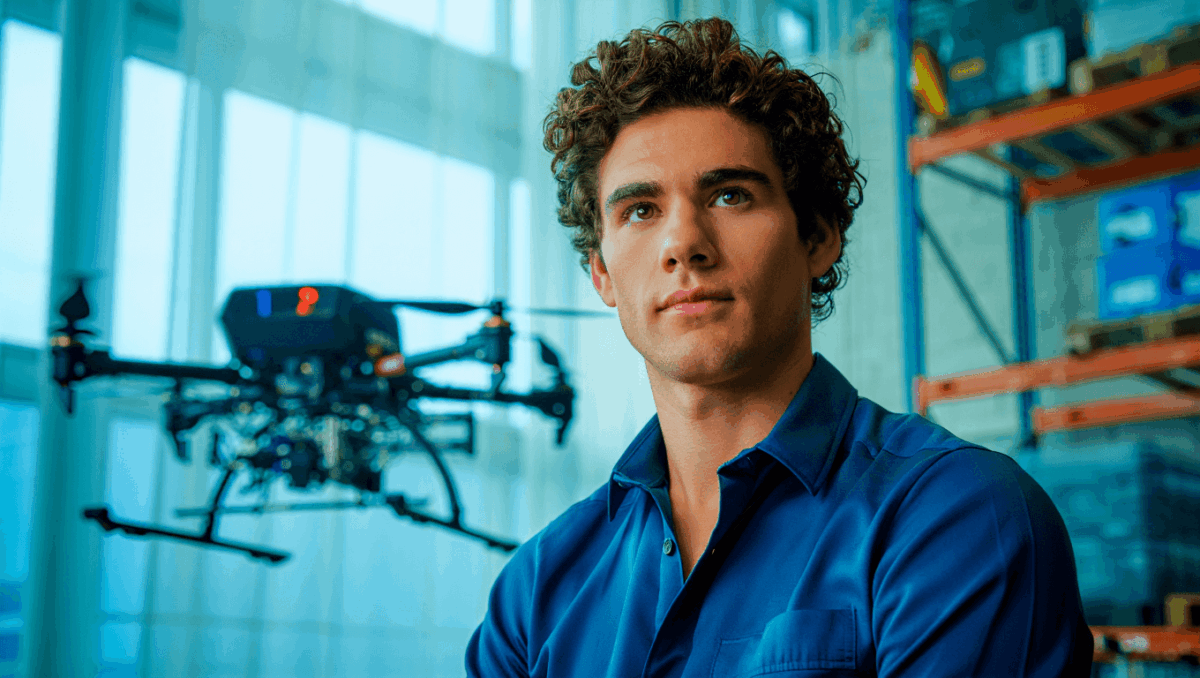
BRINC founder Blake Resnick is positioning his American-made drones for massive market dominance as a December 23 deadline looms for a Chinese competitor ban. The 25-year-old entrepreneur built a drone powerhouse that could revolutionize public safety—if the government officially blocks DJI from operating in the U.S.
🔥 Quick Facts
- BRINC faces a December 23, 2025 ban deadline that could ban all new DJI drone sales in America unless security agencies approve
- The company’s $480 million valuation is backed by Sam Altman, Peter Thiel, and Motorola after raising $157 million in funding
- Blake Resnick abandoned Northwestern University to build tactical drones, inspired by the 2017 Las Vegas shooting
- BRINC currently serves over 700 customers including the NYPD and sold approximately $15 million worth of American-made drones this year
The December 23 Deadline That Changes Everything
TurboTax Expert Full Service opens January 5, 2026, and what new tax law changes mean for your refund will surprise you
Intel stock soars 4% at open with analyst predicting $50 target, here’s why Panther Lake launch today changes everything
The DJI ban represents the most significant opportunity in drone industry history for American manufacturers. Unless the NSA or another federal security agency certifies DJI’s safety by December 23, 2025, the company will no longer be permitted to sell new drones in the United States, according to the 2025 NDAA legislation.
This deadline exists because Chinese-made devices control around 70 percent of the global drone market, worth approximately $18.6 billion in 2024 alone. Over 80 percent of American public safety organizations currently operate DJI equipment, making them dependent on Chinese technology for critical emergency services. DJI’s Matrice M30T—considered the industry gold standard—costs around $15,000, while BRINC’s comparable Responder drone starts at $20,000.
Samsung Galaxy S26 Ultra drops at $1,299 but kept one jaw-dropping feature completely secret until February 25
CES 2026 unveils $99 AI memory wearable and smart glasses that finally look normal, but Samsung’s 6K 3D display will blow your mind
China responded to BRINC’s lobbying efforts by imposing sanctions on the company and Resnick personally in December 2024, demonstrating just how seriously Beijing takes the competitive threat.
Building an American Drone Empire from Tragedy
Resnick’s journey began on October 1, 2017, when a mass shooting at the Route 91 Harvest Festival in Las Vegas killed 58 people and wounded over 400. The then-17-year-old wondered why police didn’t use drones to locate the suspect. He had been building drones since age 10, so he bombarded the Las Vegas Metro Police Department with meeting requests.
Over coffee at an Einstein Bros. Bagels, Lieutenant Will Huddler of Vegas Metro’s SWAT team skeptically listened to Resnick’s pitch. He gave the teenager 90 days to build a tactical drone prototype. On day 86, Resnick demonstrated his creation to 40 SWAT officers—only to have an officer slap it out of the air with a towel to test its durability.
Rather than give up, Resnick refined his design. Three months later, he returned with a drone that could right itself in flight. Huddler invited the entrepreneur to join SWAT ride-alongs. Together, they developed the Lemur drone, which became Resnick’s flagship product. BRINC officially incorporated in 2018.
Strategic Funding That Fueled Explosive Growth
| Funding Round | Amount | Year | Key Investors |
| Thiel Fellowship | $100,000 | 2018 | Peter Thiel |
| Initial Investment | $2 million | 2020 | Sam Altman |
| Series A | $25 million | 2021 | Index Ventures |
| Series B | $75 million | 2025 | Motorola Solutions |
The turning point came in 2020 when Sam Altman, CEO of OpenAI, reached out to Resnick directly after hearing his pitch through mutual connections. Altman responded to Resnick’s detailed email within 36 hours with a $2 million investment offer. This credibility transform helped Resnick secure subsequent funding from Alexandr Wang, Peter Thiel, and Index Ventures.
By April 2025, BRINC had raised a total of $157 million in funding. The April round specifically marked a strategic alliance with Motorola Solutions, which also led the investment. Resnick now holds an estimated 40 percent share valued at $192 million. The company has escalated its lobbying efforts, spending $660,000 on government relations over the past three years to advocate for Chinese drone restrictions.
The BRINC Product Line Dominating Police Departments
BRINC offers three primary drone products designed for emergency response scenarios. The Lemur ($10,000 base price) specializes in indoor tactical operations for SWAT teams. The Responder, launched last year at $20,000 base price, serves 911 emergency dispatch calls and can reach locations within a two-mile radius in 70 seconds or less, flying up to 42 minutes on a full battery.
The company also developed the BRINC Ball, a $2,500-and-up softball-sized device used in hostile situations where direct police contact poses risks, such as hostage negotiations or natural disasters. Queen Creek, Arizona deployed its first Responder in June 2024 and has since sent the drone on over 450 missions in less than six months—burglaries, sexual assaults, suicide prevention, and shots-fired calls—with the drone handling 35 situations entirely without officer presence.
BRINC now serves approximately 700 customers globally, including the **New York Police Department**, Immigration and Customs Enforcement (ICE), and municipal police departments ranging from small Colorado agencies to massive metros. However, BRINC currently captures only about 7 percent of the public safety drone market, compared to DJI’s dominant 80 percent share.
What Will Happen If the December 23 Ban Takes Effect?
If federal security agencies fail to certify DJI drones by December 23, BRINC could experience exponential growth as American law enforcement agencies scramble to replace their existing Chinese equipment with alternatives. Resnick estimates that a confirmed ban would create “an enormous amount of demand” for BRINC products almost overnight.
However, BRINC faces competition from Skydio, another American manufacturer based in San Mateo, California that has raised over $730 million in venture capital. The NYPD currently operates 41 Skydio drones, 40 DJI units, and only 6 BRINC devices. ICE spent $1.4 million on Skydio equipment since 2021 compared to just $80,000 on BRINC machines. Some law enforcement experts also question BRINC’s technical capabilities, citing range limitations and reliability concerns compared to DJI’s proven performance in extreme environments.
Resnick’s stated vision extends further: “The end stage here is that we’re the DJI of the West.” His office displays a framed copy of the Chinese sanctions imposed on BRINC and Resnick personally, a testament to the geopolitical stakes involved in the drone industry’s future.
Will BRINC’s market dominance strategy succeed after December 23?
The outcome depends entirely on federal agency decisions in the next 17 days. If security agencies approve DJI’s continued operation, BRINC’s valuation growth may slow considerably despite its $480 million current valuation. If the ban proceeds as scheduled, public safety organizations will face immediate pressure to transition to American alternatives like BRINC, potentially creating a multi-billion-dollar windfall for the Seattle-based manufacturer.
BRINC’s journey from a 17-year-old’s garage project to a $480 million company demonstrates American entrepreneurship in critical defense infrastructure. Whether Resnick achieves his ambition of becoming “the DJI of the West” will be largely determined by whether December 23 brings the ban Americans have been anticipating.
Sources
- Forbes – Comprehensive December 2025 profile of Blake Resnick and BRINC drones market strategy
- BRINC Official – Company announcements regarding funding rounds and product specifications
- UAV Coach – Updated 2025 DJI ban timeline and implementation guidance

Lee Ann Anderson is a technology journalist specializing in consumer tech, digital innovation, and Silicon Valley trends. With a talent for breaking down complex technical concepts into accessible insights, this skilled journalist keeps readers informed about the gadgets, apps, and breakthroughs shaping our digital future. Her coverage bridges the gap between tech enthusiasts and everyday users.