
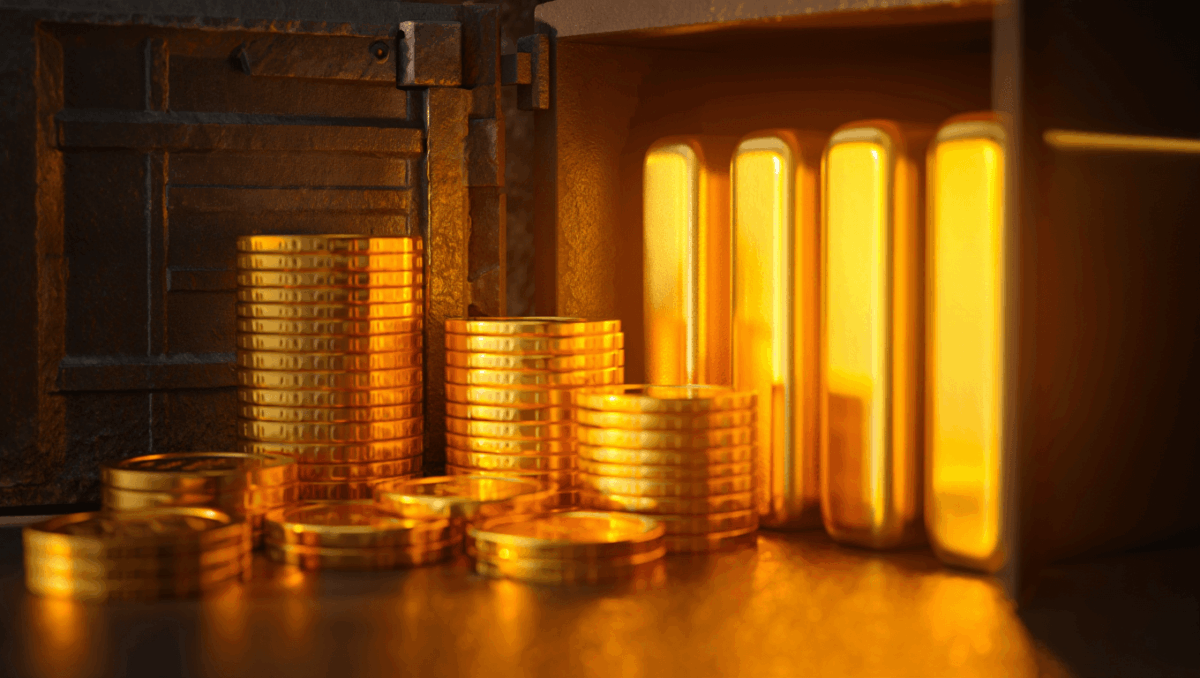
Gold is soaring past $4,500 per ounce as safe-haven demand surges. The Federal Reserve’s expected rate cuts are fueling this historic rally. This precious metal is on track for its strongest year since 1979.
🔥 Quick Facts
- Gold hit $4,561 per ounce on December 26, 2025 in early Asian trading, marking new record highs
- 72% gain in 2025 represents the strongest annual performance since 1979, driven by central bank buying and inflation concerns
- Safe-haven demand surging as geopolitical tensions and economic uncertainty push investors toward precious metals
- Fed rate-cut expectations support continued gold buying, with analysts forecasting potential $5,000 levels by end of 2026
Gold Breaks Through the $4,500 Barrier Amid Record Momentum
Intuit emerges as best software stock for 2026 while stock crashes to bargain levels analysts didn’t expect
2026 tax brackets shock Americans with hidden paycheck truth nobody expected
The precious metal shattered the $4,500 psychological barrier during December 2025 trading sessions. On December 24, gold initially surged past this key level, hitting highs of $4,525.18 per ounce before consolidating. By December 26, gold climbed even higher, reaching $4,561 in early Asian trading sessions.
This relentless rally marks a watershed moment for the commodity markets. Spot gold at $4,510.92 on December 26 represents a 72% annual gain, making 2025 the strongest year for gold since 1979 under President Jimmy Carter. The momentum reflects a fundamental shift in how investors perceive safety and value.
Safe-Haven Demand Drives the Rally as Uncertainties Mount
Marcus Lemonis takes CEO role at Bed Bath & Beyond with $25M cost-cutting plan and watch what industry experts are saying about his next move
SPX surges 34 points at open with shocking tech recovery, here’s what caused the unexpected Venezuela rally
Investors worldwide are treating gold as the ultimate insurance policy. Rising geopolitical tensions, including regional conflicts and trade uncertainties, have sparked demand for assets that preserve wealth when everything else struggles. Central banks are aggressively buying gold to diversify away from weakening currencies.
The World Gold Council reports that central bank demand hit record levels throughout 2025. In October alone, central banks purchased 53 tons of gold—a 36% monthly increase. This institutional buying creates a floor under prices that retail investors had not seen in decades.
Federal Reserve Rate-Cut Expectations Fuel Gold’s Ascent
| Factor | Impact on Gold |
| Lower Interest Rates | Reduces opportunity cost of holding non-yielding gold; makes borrowing cheaper to purchase gold |
| Weak Dollar Environment | Makes gold cheaper for international buyers; historically negative correlation with USD strength |
| ETF Inflows | Strong demand from exchange-traded funds adds technical support; $4,519 range now key support level |
| Inflation Hedge | Gold gains when purchasing power erodes; serves as tangible store of value against currency debasement |
Markets are pricing in additional Federal Reserve rate cuts throughout 2026. Lower rates directly benefit gold by reducing yields on competing assets like bonds. When interest rates fall, holding gold becomes more attractive since the opportunity cost disappears.
As of December 26, 2025, forward guidance suggests at least 75 basis points of cuts could occur in 2026. Some analysts expect even more aggressive easing if economic growth slows. This prospect keeps gold investors optimistic about sustained momentum heading into the new year.
Expert Price Targets Point Toward $5,000 and Beyond
Wall Street’s major investment banks have become increasingly bullish on gold’s trajectory. Goldman Sachs expects $4,900 per ounce by December 2026—a 14% upside from current levels. This conservative estimate assumes stable geopolitical conditions and moderate Fed easing.
More aggressive forecasts are emerging from other major institutions. Societe Generale strategists predict gold could hit $5,000 per ounce by the end of 2026. Some analysts mention $6,000 as a possibility in scenarios involving severe currency weakness or severe geopolitical escalation.
Technical analysis supports these targets. J.P. Morgan’s research team notes that $4,520 represents a key support level. Breaking above this level creates momentum toward $4,715, then potentially $4,900 and beyond. Year-end positioning suggests limited resistance until $4,600.
What Makes This Rally Different From Previous Gold Bubbles?
Unlike speculative bubbles of the past, this rally rests on fundamental structural demand. Central banks are not reverting to traditional diversification—they are accelerating their accumulation. Investors cite legitimate concerns about debt sustainability, currency debasement, and geopolitical fragmentation.
The breadth of participation is also unprecedented. Retail investors, institutional hedge funds, central banks, and commodity traders all own gold simultaneously. This diverse ownership base prevents the sharp reversals that characterized previous cycles. Central bank demand alone provides a 53-ton monthly floor under prices.
“The extraordinary surge in gold prices is likely to continue, supporting our forecast of $5,000 per ounce by end-2026.”
— Societe Generale Commodities Team, Investment Analysis
Sources
- Bloomberg – Real-time gold pricing and market analysis
- Reuters – Central bank demand data and precious metals reporting
- CNBC – Federal Reserve policy impact on commodities

Patrick Graham is a business and finance journalist translating Wall Street’s complexities into stories that matter to everyday readers. With extensive experience in financial journalism and economic analysis, this expert journalist provides sharp insights on market trends, corporate developments, and the economic forces affecting daily life. His reporting helps readers make sense of the business world’s biggest moves.