
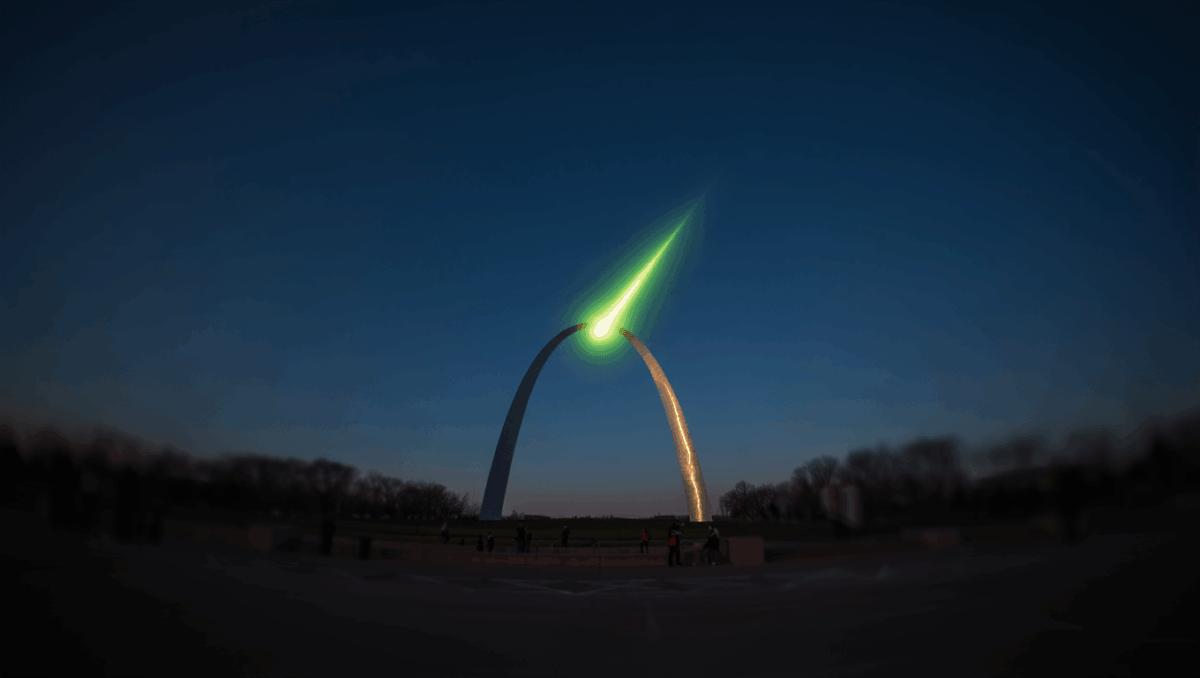
St Louis Arch’s most unforgettable New Year’s Eve moment happened at dawn when a brilliant green meteor streaked over the iconic landmark. Hours before celebrants gathered for Winterfest’s ‘Neon Nights’ family celebration, nature put on its own spectacular light show—captured perfectly by a camera watching from across the Mississippi River.
🔥 Quick Facts
- Time of sighting: 5:22 a.m. CST on December 31, 2025
- Location captured: EarthCam network camera at Malcolm Martin Memorial Park in East St. Louis
- Meteor appearance: Green glowing fireball that traveled north to south, extinguishing directly over the Gateway Arch peak
- Coming attraction: Quadrantid meteor shower will peak January 3-4, 2026 with up to 25 meteors per hour
St Louis Arch Gets Cosmic Send-Off Before New Year Party
America’s Next Top Model documentary drops today on Netflix with shocking revelations
Dana Eden dies at 52, Tehran producer found dead in Athens hotel
The 6-second video capturing nature’s goodbye to 2025 immediately went viral across social media. A small white speck appeared over the eastern horizon, then blossomed into a luminous green blaze that pulsed once before disappearing as it reached the exact peak of the Gateway Arch.
The Gateway Arch’s official social media account posted the footage with the caption: “HEY LOOK, it’s… A meteor saying hi to the Gateway Arch on New Year’s Eve!” Users couldn’t stop commenting about the timing—as if the universe was sending one final hello before the calendar reset.
Why the Meteor Glowed Green During Descent
Tommy Lee Jones’ daughter was pregnant before her tragic death, court docs reveal
J Cole announces The Fall-Off world tour, first global dates in decades
Meteorologist Angela Hutti from FOX 2 Now explained the stunning color phenomenon. The green hue results from atmospheric friction as the rocky object burns up entering Earth’s atmosphere at extreme velocity.
Scientists distinguish between three stages: a meteoroid while in space, a meteor during the atmospheric burn creating the visible streak, and a meteorite if it survives and strikes ground. This particular specimen never reached the ground level. The green glow specifically indicates chemical composition—different space rocks produce different colors when burning up.
EarthCam Network Captures Rare Monument Alignment
| Meteor Event Details | Information |
| Recording Device | EarthCam network fixed camera |
| Camera Location | Malcolm Martin Memorial Park, East St. Louis |
| Sighting Time (CST) | 5:22 a.m., December 31, 2025 |
| Duration | Approximately 6 seconds |
| Travel Path | North to south, extinguishing over Arch peak |
The EarthCam network operates 24/7 live cameras worldwide capturing time-lapse footage and current conditions. The St. Louis camera is positioned directly facing the downtown skyline, making it the perfect witness to this celestial moment. Thousands of viewers discovered this incredible footage through the network’s social integration.
Winterfest ‘Neon Nights’ Celebration Follows Hours Later
Ironically, while the meteor streaked overhead in predawn darkness, St. Louis was preparing for its annual family-friendly New Year’s Eve celebration. The Gateway Arch Foundation’s tenth annual Winterfest had been running since November 22 and culminated with the family-oriented “Neon Nights” event.
Thousands from the Missouri region would gather at Kiener Plaza near the iconic monument later that morning for festivities designed specifically for children and families before the evening ball drop celebrations. The early-morning meteor essentially previewed the night’s magic hours before the crowd arrived.
Why the Quadrantid Meteor Shower is Worth Watching This Week?
The St. Louis meteor on New Year’s Eve wasn’t an isolated event—it was a preview of coming attractions. The Quadrantid meteor shower, one of the most reliable annual events, reaches its peak between January 3 and 4, 2026.
Observers can expect approximately 25 meteors per hour during the peak window, compared to random events like the New Year’s Eve fireball. The shower remains active through January 12, with the best viewing occurring during predawn hours before sunrise. Unlike most meteor showers originating from comet debris, the Quadrantids come from asteroid 2003 EH1. The next major meteor shower won’t occur until April.
Watch the Moment:

Sources
- New York Post – Coverage of meteor streaking over Gateway Arch on New Year’s Eve
- FOX 2 Now – Meteorologist Angela Hutti’s analysis of the green meteor phenomenon
- EarthCam Network – Live camera footage and worldwide network documentation

Jessica Morrison is a seasoned entertainment writer with over a decade of experience covering television, film, and pop culture. After earning a degree in journalism from New York University, she worked as a freelance writer for various entertainment magazines before joining red94.net. Her expertise lies in analyzing television series, from groundbreaking dramas to light-hearted comedies, and she often provides in-depth reviews and industry insights. Outside of writing, Jessica is an avid film buff and enjoys discovering new indie movies at local festivals.