
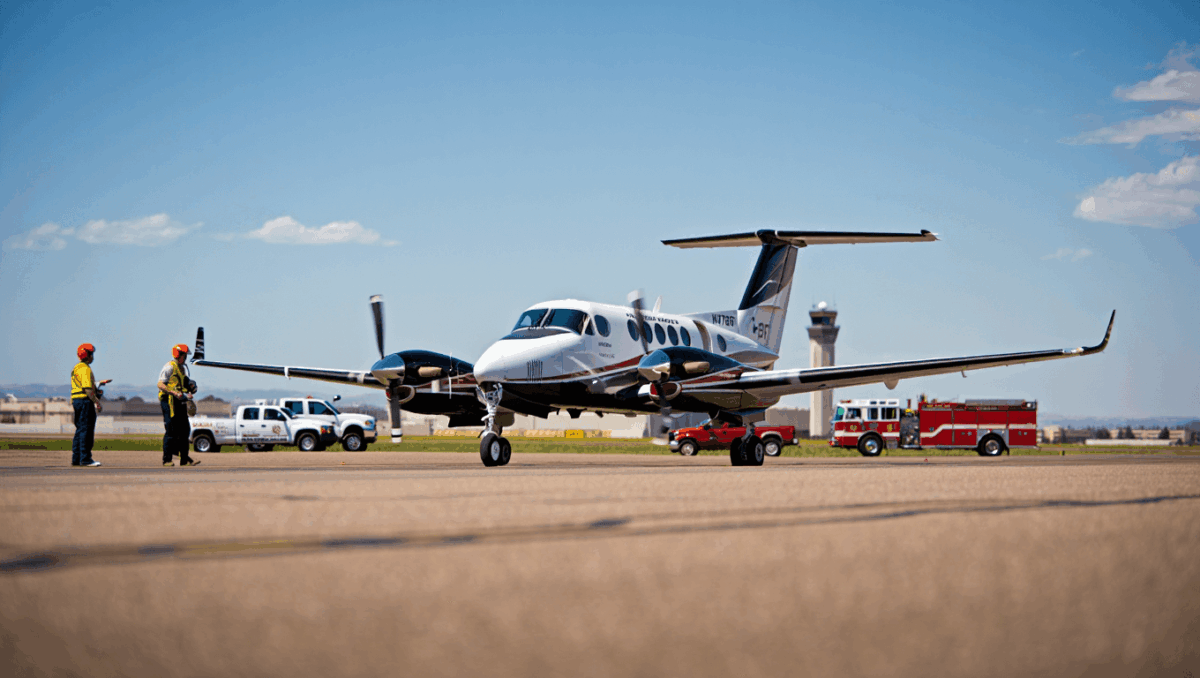
Garmin’s Autoland system just achieved an extraordinary milestone—successfully landing a Beechcraft King Air 200 aircraft in Colorado after a pilot emergency on December 20, 2025. This marks the first real-world activation of the groundbreaking autonomous emergency landing technology in aviation history. Two crew members on board the N479BR aircraft walked away safely from what could have been a catastrophic situation.
🔥 Quick Facts
- Date: December 20, 2025 at approximately 2 p.m. local time
- Location: Rocky Mountain Metropolitan Airport in Broomfield, Colorado, west of Denver
- Aircraft: Beechcraft Super King Air B200 equipped with Garmin G1000 NXi avionics and Emergency Autoland system
- Outcome: Both crew members emerged unscathed after the system landed the aircraft safely with zero casualties
How Garmin’s Emergency Autoland System Works
Intuit emerges as best software stock for 2026 while stock crashes to bargain levels analysts didn’t expect
2026 tax brackets shock Americans with hidden paycheck truth nobody expected
Garmin’s Emergency Autoland represents a revolutionary leap in flight safety technology. When activated, the system takes complete control of the aircraft and flies it autonomously to the nearest suitable airport. The system continuously monitors fuel levels, aircraft altitude, and available landing facilities to make real-time decisions.
The technology was originally designed for single-engine aircraft like the Cirrus Vision Jet, but Garmin extended it to twin-engine business aircraft including the King Air series. The system analyzes weather, runway conditions, and approach angles before carefully maneuvering the aircraft for a controlled landing. Throughout the descent, the Emergency Descent Mode (EDM) works in conjunction with Autoland to maintain safe airspeed and cabin pressurization.
The Colorado Emergency: What Triggered the Activation
Marcus Lemonis takes CEO role at Bed Bath & Beyond with $25M cost-cutting plan and watch what industry experts are saying about his next move
SPX surges 34 points at open with shocking tech recovery, here’s what caused the unexpected Venezuela rally
The King Air 200 was flying from Aspen to Denver when the crew experienced a critical in-flight emergency. Initial reports indicated pilot incapacitation was declared by the system’s radio alert, though later clarifications revealed the activation was actually triggered by rapid cabin pressurization loss. The crew made the decision to engage the Autoland system after determining manual flight control was no longer viable.
Within minutes, the aircraft’s Garmin G1000 NXi avionics suite took control of the flight surfaces and navigation systems. The system immediately evaluated nearby airports and selected Rocky Mountain Metropolitan Airport (KBJC) as the optimal landing site. The aircraft descended automatically, adjusted flight path corrections, and touched down safely on the runway at 2 p.m. local time.
Technical Specifications and System Architecture
| System Component | Details |
| Aircraft Type | Beechcraft Super King Air 200 |
| Avionics System | Garmin G1000 NXi integrated flight deck |
| Autopilot Technology | Garmin Autonomy Emergency Autoland |
| Landing Airport | Rocky Mountain Metropolitan Airport (KBJC) |
| Fuel Monitoring | Real-time fuel flow analysis and burn rate calculation |
| Safety Features | Under-speed protection, descent rate limiting, go-around capability |
Aviation Industry Celebrates Historic Achievement
Garmin Aviation announced this historic achievement as proof that autonomous emergency systems can save lives in real-world scenarios. The FAA and NTSB are investigating the incident to document the system’s performance and gather data for future aircraft certification. Industry experts emphasize that this successful activation validates years of development and testing.
Aviation organizations and Beechcraft operators are now evaluating the system’s broader implementation. The King Air B200 joins other Garmin Autoland-equipped aircraft including the Piper M600 SLS, Cirrus Vision Jet, Daher TBM series, and Piper Fury. Analysts predict this technology could become a standard feature across the business aviation sector within the next five years.
What This Means for the Future of Aviation Safety?
The successful landing in Colorado demonstrates that autonomous systems can operate reliably during genuine emergencies. This breakthrough also raises important questions about pilot training, system limitations, and regulatory frameworks. Will more aircraft manufacturers adopt similar technology? How will this change insurance requirements for professional aviation?
The King Air Autoland activation represents a watershed moment where technology transitions from theoretical promise to practical lifesaving reality. Future pilots may depend on these systems as a essential safety net, comparable to parachute technology in aviation history.
“The successful landing of the King Air B200 demonstrates that our Emergency Autoland system is ready to save lives in real-world scenarios.”
— Garmin Aviation, Official Statement
Watch: Garmin Autoland Emergency Landing Footage
Sources
- Garmin Aviation – Official company statement and system specifications
- CNN – Breaking news coverage of the Colorado emergency landing
- ABC News – First-use confirmation of Autoland system in emergency situation

Patrick Graham is a business and finance journalist translating Wall Street’s complexities into stories that matter to everyday readers. With extensive experience in financial journalism and economic analysis, this expert journalist provides sharp insights on market trends, corporate developments, and the economic forces affecting daily life. His reporting helps readers make sense of the business world’s biggest moves.