
Need to know
need-to-know
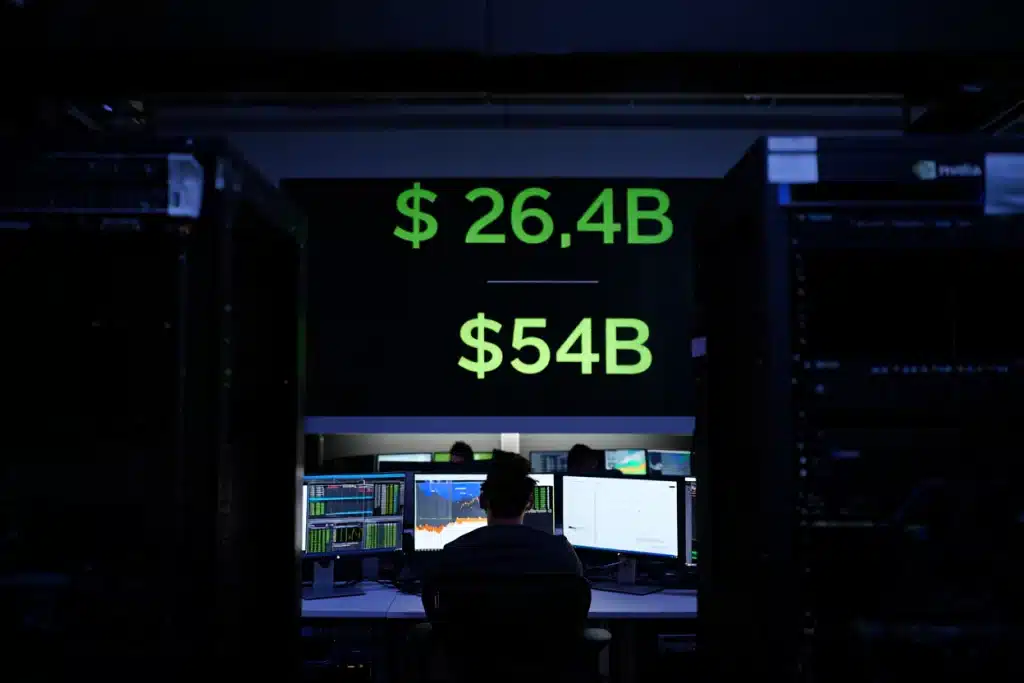
- Nvidia posts $46.7B fiscal Q2 2026 revenue; net income $26.4B.
- Jensen Huang projects $3–$4T AI infrastructure spend by decade’s end.
- Stock dips ~1.6% premarket after $54B Q3 revenue outlook.
- No H20 shipments to China in Q2; $650M H20 sold to non‑China customer.
- Data center revenue hits $41.1B; Blackwell sales total $27B in quarter.
- Outlook excludes China; policy uncertainty clouds near‑term shipments.
Why a $46.7B quarter and a $4T bet reshape AI through 2026
Nvidia’s latest results underscore a structural shift: AI data centers are becoming the decade’s defining buildout. The company booked $46.7B revenue and $26.4B profit in fiscal Q2 2026, while CEO Jensen Huang framed a multi‑trillion‑dollar runway for AI infrastructure by 2030. That top‑down thesis aligns with hyperscaler capex momentum today and Blackwell demand already “sold out” into 2026. The hitch: shares eased as near‑term guidance met sky‑high expectations and China remained uncertain. The long arc looks powerful; quarter‑to‑quarter timing—and geopolitics—still matter.
Voices and reactions
Powerball winner scoops $1.817 billion on Christmas Eve, what happens next will change their life forever
Zendaya shuts down pregnancy rumors after viral London outing with Tom Holland goes too far—here’s what she actually said
Huang: “A new industrial revolution has started. The AI race is on.” He pegged potential AI infrastructure spend at $3–$4 trillion by the end of the decade and said customers can process more data with less energy using Nvidia’s platforms. Some investors see durability in the trade, citing persistent hyperscaler capex and order books “largely spoken for” on Blackwell, even as broader AI stocks show signs of fatigue.
The data behind Nvidia’s AI surge: capex, backlogs, China risk
Huang cited roughly $600B in data center capex this year from major customers. On a single $60B AI data center, he suggested Nvidia could capture about $35B—illustrating how platform depth (GPUs, networking, software) drives wallet share. With Blackwell demand locked up into 2026 and Hopper still moving, supply ramps are the near‑term lever. China is the pressure point: Nvidia reported no H20 shipments to China in Q2; one non‑China buyer purchased $650M of H20, signaling redirected demand while regulatory details remain unsettled.
The numbers that change the game
kpi
Indicator Value Period Change/Impact Revenue $46.7B Fiscal Q2 2026 +56% YoY Net income $26.4B Fiscal Q2 2026 +59% YoY Data center revenue $41.1B Fiscal Q2 2026 +56% YoY Blackwell sales $27B Fiscal Q2 2026 Dominant share of DC revenue Q3 revenue outlook $54B (±2%) Fiscal Q3 2026 Slight miss vs exuberant hopes; stock dip H20 shipments to China $0 Fiscal Q2 2026 Paused amid policy uncertainty H20 sold outside China $650M Fiscal Q2 2026 Demand redirected to non‑China buyer AI infra spend forecast $3–$4T By ~2030 Signals long runway for Nvidia Summary: Record quarter, strong outlook; China policy is the swing variable.
Why Wall Street cheers profits but punishes Nvidia’s 2026 outlook
Arkansas lottery wins $1.817 billion Powerball jackpot on Christmas Eve, here’s what happens to the money
Powerball winner scoops $1.817 billion jackpot on Christmas Eve, but nobody knows who they are yet
A record quarter and robust margins usually lift shares. This time, the stock slipped as the $54B Q3 guide didn’t clear a lofty bar, and China remained excluded from forecasts. Investor debate centers on pacing: are we seeing digestion before the next supply wave—or an early signal of slower incremental beats after a historic run? With Blackwell backlogs and hyperscaler builds intact, the long case holds; the near‑term hinges on shipments, lead times, and any China thaw.
Licenses, tariffs, and China: the 2025–2026 regulatory clock
Nvidia reported no H20 shipments to China in Q2 while noting licenses issued to select China‑based customers. The company’s Q3 outlook explicitly excludes China contributions, reflecting uncertainty around export permissions and a 15% U.S. export‑tax arrangement reported in recent coverage. China’s discouragement of Nvidia chips adds another layer of risk. Net: policy cadence, not demand, is gating near‑term sales; any regulatory clarity could swiftly re‑route supply.
How 2026 supply ramps and Blackwell demand could reset growth
Nvidia says Blackwell is “the platform at the center” of the AI race, and order books suggest that’s true into 2026. As new capacity comes online, revenue mix could tilt further toward high‑end racks, sustaining dollar‑content per data center. Older Hopper devices still selling implies layered demand across tiers. If shipment timing improves and China ambiguity eases, 2026 could mark another leg higher in both units and platform revenue.
What buyers should know right now
Enterprise buyers should expect tight allocations: “everything sold out” remains the operative phrase. Plan earlier for power, cooling, and networking alongside GPU slots, and consider staged deployments that blend Blackwell with Hopper where appropriate. Nvidia’s pitch is better performance per watt at scale; that ROI math resonates in 2025, but delivery windows—and policy gating for China—will dictate how quickly plans become capacity.
Sources
- https://www.reuters.com/business/nvidia-ceo-says-ai-boom-far-over-after-tepid-sales-forecast-2025-08-28/
- https://techcrunch.com/2025/08/27/nvidia-reports-record-sales-as-the-ai-boom-continues/
- https://www.theverge.com/news/767142/nvidia-seems-unstoppable

Jessica Morrison is a seasoned entertainment writer with over a decade of experience covering television, film, and pop culture. After earning a degree in journalism from New York University, she worked as a freelance writer for various entertainment magazines before joining red94.net. Her expertise lies in analyzing television series, from groundbreaking dramas to light-hearted comedies, and she often provides in-depth reviews and industry insights. Outside of writing, Jessica is an avid film buff and enjoys discovering new indie movies at local festivals.